Missteps in Polling: The 1936 Literary Digest Prediction vs. Roosevelt's Actual Victory
60 likes | 196 Vues
The 1936 Literary Digest Poll, a significant moment in election history, famously predicted Franklin D. Roosevelt would receive only 43% of the vote against Alf Landon. However, Roosevelt secured a staggering 62% in the election, leading to the collapse of the Digest due to its polling inaccuracies. The poll's biases stemmed from a non-representative sampling frame that favored wealthier, Republican respondents. In contrast, George Gallup utilized random sampling to provide a more accurate prediction, highlighting flaws in data collection techniques and foreshadowing future polling methods.


Missteps in Polling: The 1936 Literary Digest Prediction vs. Roosevelt's Actual Victory
E N D
Presentation Transcript
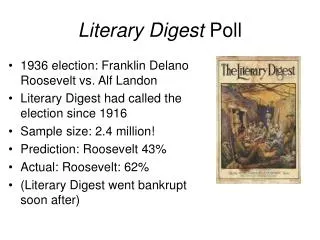
Literary Digest Poll • 1936 election: Franklin Delano Roosevelt vs. Alf Landon • Literary Digest had called the election since 1916 • Sample size: 2.4 million! • Prediction: Roosevelt 43% • Actual: Roosevelt: 62% • (Literary Digest went bankrupt soon after)
What went wrong? • Context • 9 million unemployed; real income down 1/3 • Landon: “Cut spending” versus Roosevelt: “Balance peoples’ budgets before government’s budget • Polling • Survey sent out to 10 million people from subscription list, telephone directories, club membership lists • 2.4 million responded
Sources of bias • Sampling frame not representative • Biased toward better off groups (and more Republican) • Voluntary response bias • The anti-Roosevelt forces were angry---and had a higher response rate!
George Gallup did it right • Roosevelt’s percentage • Actual election result: 62% • Literary Digest prediction: 43% • Gallup’s prediction of the Digest prediction (based on sample of 2,000) 44% • Gallup’s prediction of the election result (based on sample of 50,000) 56% • Gallup used Random sampling
The Year the Polls Elected Dewey • 1948: Harry Truman (Dem) vs. Thomas Dewey (Rep) • All major polls predicted Dewey would win by 5 percentage points (even Gallup)
What went wrong? • Quota Sampling • Each interviewer assigned a fixed quota of subjects in certain categories (race, sex, age) • In each category, interviewers free to choose • Left room for human choice---and inevitable bias • Republicans were easier to reach • Had telephones, permanent addresses, “nicer” neighborhoods • Quota sampling abandoned for Random Sampling