The Washington Presidency
60 likes | 211 Vues
The Washington Presidency established foundational precedents that shaped the U.S. government. From forming the first Cabinet to suppressing the Whiskey Rebellion, his actions created lasting traditions. Alexander Hamilton advocated for a strong national government with measures like federal debt assumption, tariffs, and a national bank, embodying a "loose constructionist" view. In contrast, Thomas Jefferson, as Secretary of State, pushed for a limited federal government, emphasizing states' rights and strict interpretation of the Constitution. This ideological divide laid the groundwork for America's first political parties.


The Washington Presidency
E N D
Presentation Transcript
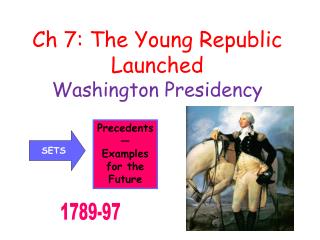
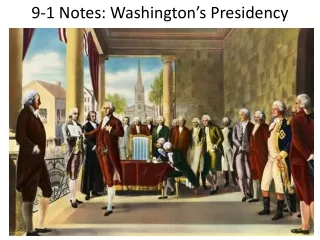
Precedents… • Everything Washington did set a precedent (a example, tradition, etc.) • First Cabinet • Used force to put down the Whiskey Rebellion. • Voluntary Two Term Limit
Alexander Hamilton • Wanted a Stronger National Government • “Loose Constructionist:” Believed “Elastic Clause” gives the national government “implied powers”
Summary of Hamilton’s Plan DEBT ↓ TAXES ↓ BANK • Federal assumption of war debts in order to establish credit and give investors a material interest in the survival of the federal government. • Adoption of a tariff on imported manufactured goods in order to encourage domestic industrial growth. • Creation of a national bank to finance internal improvements.
Thomas Jefferson • Secretary of State • Strict Constructionist (No Implied Powers) • Thought National Bank was unconstitutional because no delegated power authorized it. • Wanted weak national government and strong state governments