
Understanding Ionic Conduction in Fuel Cells and Crystal Structures
E N D
Presentation Transcript
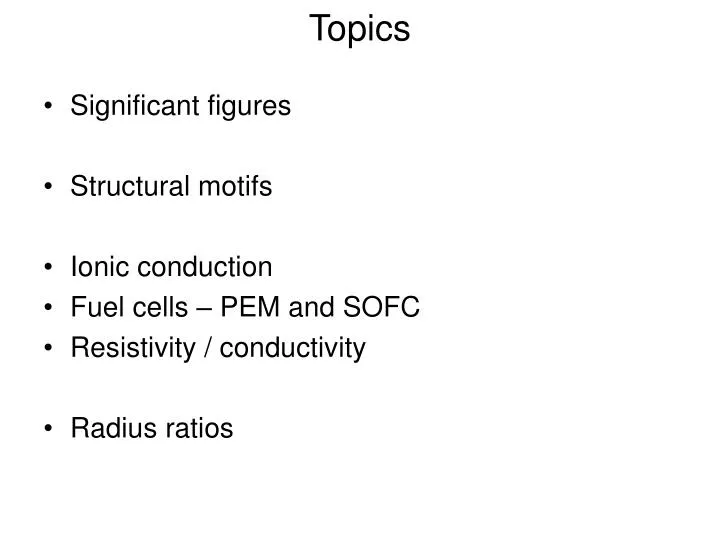
Topics • Significant figures • Structural motifs • Ionic conduction • Fuel cells – PEM and SOFC • Resistivity / conductivity • Radius ratios
Cu2HgI4 ZnS Disordered high-T (left) and ordered low-T (right) unit cell of Cu2HgI4. In the disordered phase, there are on average two Cu+ ions and one Hg2+ ion for every four Iˉ anions. However, the positions of these cations are not fixed – in any given unit cell, it is expected that these three cations will occupy a random subset of the four potential tetrahedral Cu/Hg sites, marked in gray. Single (left) and doubled (right) unit cell of ZnS (zinc blend structure) Voids and conduction
Ionic conduction • For two cations of the same size but different charge, which will be held less tightly by the lattice? • For two cations of the same charge but different sizes, which will move more easily through the lattice? Larger charge Smaller charge Larger size Smaller size
Sizes of voids in spherical packings (See structure image for BCC structure in Diamond) • A sphere of this size (relative to the lattice of size of its neighbors) is just able to touch all off its neighbors for the void geometries below.
Resistivity and conductivity • V = IR R = V / I (W = V/A) h w l • R al R a 1/w R a 1/h [R a 1/Area] (W cm) (S cm-1) Siemens = 1/W