Understanding Triangles: Definitions, Types, and Properties
In this lesson, you will explore the definitions and classifications of triangles and their components. Learn about different types of triangles: those with one right angle, all angles acute, or one angle obtuse. Discover unique properties such as isosceles triangles, where two sides are equal in length, and the significance of base angles. We will also discuss how triangles are classified based on side lengths and angle measures. Engage in activities to solidify your understanding of triangle properties and relationships.

Understanding Triangles: Definitions, Types, and Properties
E N D
Presentation Transcript
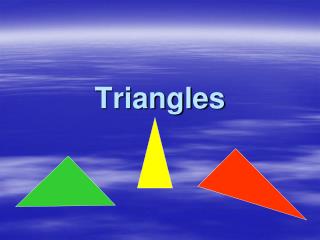
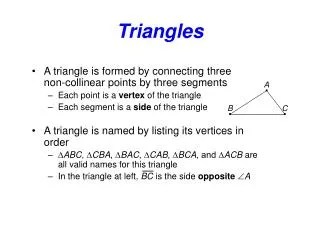
Defining Triangles During this lesson, you will define triangles and their parts.
∆ w/ exactly one right (90 degree) angle ∆ w/ all angles measuring < 90 degrees ∆ w/ exactly one angle measuring > 90 ∆ w/ no sides equal in measure ∆ w/ at least 2sides equal in measure ∆ w/ all sides congruent Segment of a ∆ which connects the vertex of one angle w/ the mid- point of the opposite side Perpendicular segment in a ∆ from a vertex to its opposite side
Isosceles Triangle Parts In an isosceles triangle, the angle between the two sides of equal length is called ________________________________. The side opposite the vertex angle is called the _________ of the isosceles triangle. The two sides of equal length are called the ____________. The two angles opposite the two sides of equal length are called the ____________ of the isosceles triangle. vertex leg leg Base angles Base
Final Checks for Understanding • Triangles can be classified by ____________________________. • True or False. Explain. An equilateral triangle is isosceles. • Name (and describe) the ways in which we classify triangles by the lengths of their sides. • Name (and describe) the ways in which we classify triangles by the measures of their angles.