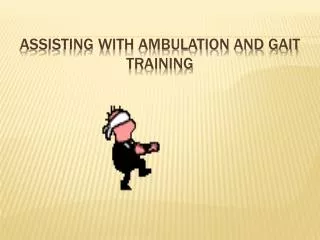
Assisting with Ambulation
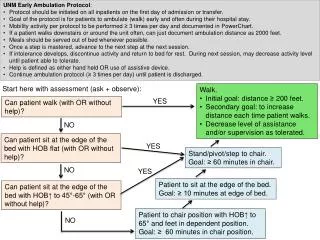
Assisting with Ambulation. Teresa V. Hurley, MSN, RN. Dangling a Client. Prevent injury Seated position at side of bed with feet touching the floor Gaze looking forward What is orthostatic hypotension?. Ambulation. Stand erect Gaze forward Heel to toe

Assisting with Ambulation
E N D
Presentation Transcript
Assisting with Ambulation Teresa V. Hurley, MSN, RN
Dangling a Client • Prevent injury • Seated position at side of bed with feet touching the floor • Gaze looking forward • What is orthostatic hypotension?
Ambulation • Stand erect • Gaze forward • Heel to toe • Opposite arm swing to opposite leg
Nursing Assistance • One Nurse Assist • Two Nurse Assist
Special Consideration • Client has one-sided weakness or paralysis • Nurse stands on the weaker or affected side • With arm around waist to stabilize the client
Preventing Injury: Falls • Client begins to fall or feels faint • What are you going to do?
Nurse Guides to Floor • Move hip forward closest to client with a wide base of support and have client slide down your leg into a sitting or lying position
Walking Assistive Devices • Canes • Walkers • Braces • Walking belts
Canes • Single-ended curve ended ideal for use with stairs • Single-ended straight ended used when balance is intact and hand weakness exists • Multi-prong used when there is balance problems because it has a wide base of support
Canes • Rubber tipped • Sizing: bottom 4 inches to side of foot • Sizing: top reaches hip joint • Held with stronger side with elbow bent at 30 degree angle • Weight evenly distributed • Advance weaker leg and cane simultaneously • Swing stronger leg • Avoid leaning forward
Walkers • Client picks up walker and advances as steps ahead • Impaired side advances first ahead after picks up walker
Braces • Support joints and muscles that can not support body weight
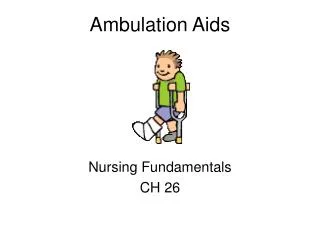
Crutches • Reliance on strength of arms and shoulders • Limit or eliminate weight bearing • Forearm Support Crutches used for permanentlimitations • Axillary Crutches used for short or long term
Axillary Crutches • Body weight carried on arms and hands and not axilla • 2 Point Gait and 4 Point Gait used for partial weight bearing • 3 Point Gait non-weight bearing • Swing to and Swing through for weight bearing • Upstairs lead with unaffected and going down stairs lead witheffected
Crutches • Measure by lying flat in bed with shoes used for walking • Measure from anterior fold of axilla to the heel and add 1 inch = 2.5 cm • Standing position: crutch pad should be three finger breaths from anterior fold of axilla