Enhancing Student Literacy Through "Words Their Way" - Phonics, Spelling, and Vocabulary Strategies
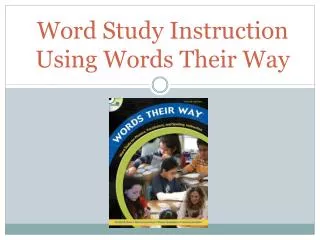
This study group focuses on the "Words Their Way" framework for teaching phonics, spelling, and vocabulary based on developmental and instructional levels. Students learn through comparing and contrasting word features, fostering natural learning inclinations. Participants will explore assessment types, grouping for instruction, and daily routines for word study, as well as resources for ongoing assessment. The session will delve into the importance of various literacy components and effective instructional strategies to enhance student learning outcomes.

Enhancing Student Literacy Through "Words Their Way" - Phonics, Spelling, and Vocabulary Strategies
E N D
Presentation Transcript
Words Their Way Study Group Sessions 1-6
Tenets of Word Study • Students’ learning of phonics, spelling, and vocabulary is based on their developmental or instructional level. • Students’ learning is based on the way they are naturally inclined to learn; through comparing and contrasting word features and discovering consistencies.
How does AISB compare? • End of Year goals • Kindergarten: Middle letter name-alphabetic • Grade 1: Early within word pattern • Grade 2: Late within word pattern • Grade 3: Early syllables and affixes • Grade 4: Late syllables and affixes • Grade 5: Derivational relations
Assessment and Grouping • How often will we assess? • Which assessments will we use? • 3. Which documents will be useful in organizing the results?
Resources • On-line PD Portal - http://pdtoolkit.pearson.com/ • Words Their Way Supplements
Assessment Review • Do you feel confident in scoring the assessment? If not, what is unclear to you? • What did you learn from the assessment/s that you administered? • How will you group your students for instruction? • How will you use the assessment to inform your instruction?
Types of Sorts • Sound Sorts Writing Sorts • Pattern Sorts Blind Writing Sorts • Meaning Sorts Word Hunts • Teacher Directed Closed Sort Brainstorming • Teacher Directed Guess My Category Speed Sorts • Student Centered Closed Sort Draw and Label • Student Centered Open Sort Blind Sorts • Repeated Sorts Buddy Sorts
Organization • What will your weekly word study routine look like? • What will your word sorts look like? (cut out paper, written, electronic, etc..?) • How will students organize their learning (folder, notebook, envelope, bag, etc..?) • How will you communicate to your parents (letter, website, etc..?)
Six Components of Early Literacy • Oral Language, Concepts, and Vocabulary • Phonological Awareness • Alphabet Knowledge • Letter-Sound Knowledge • Concepts about Print (CAP) • Concept of Word (COW)
What does the Emergent stage look like? • http://www.pearsoncustom.com/us/coco_wordstheirway/ • Username: lmiller@aisb.hu • Password: Budapest12
Letter Name-Alphabetic stage • Stage description • Teacher led group example • http://www.pearsoncustom.com/us/coco_wordstheirway/ • Username: lmiller@aisb.hu • Password: Budapest12
What do these students need to learn? • Sight words • Vocabulary • Short vowel sounds (CVC pattern) • Digraphs (ph, sh, ch, wh) • Blends (bl, st, br) • Preconsonantal nasals (-nk, -ng. -mp) • Influenced vowels (r, w, l)
What resources are beneficial? • Predictable texts • Personal readers • Word banks
Assessment • Ongoing assessment – observe sorting, pasting sorts • Sight word checks • Weekly Spelling Checks – 5 to 10 words (sort words and transfer words) • Resources online - http://pdtoolkit.pearson.com/
Children in this stage should…. • Study and apply knowledge of vowel patterns, influenced vowels, homophones, and homographs • Use a (personal) word wall as a resource for spelling high frequency words • Read and write independently for at least 30 minutes a day • Receive explicit vocabulary instruction focused on meaning of words • Experience daily read alouds • Begin using online and print dictionaries as resources • Begin studying simple prefixes and suffixes
Benchmark of stages • Emergent – Sound symbol correspondence, development of concept of word • Letter Name – Most single syllable short vowel words are spelled correctly, shift to silent reading • Within Word Pattern – Most single syllable long vowel words are spelled correctly • Syllables and Affixes – Most frequently used and polysyllabic words are spelled correctly • Derivational Relations – Most words are spelled correctly
Video Viewing • Organization with students in the within word pattern stage – 2 • http://pdtoolkit.pearson.com
Types of sorts • Picture sorts to contrast long and short vowels • Teacher-directed 2 step sorts for long vowels • Open Sorts
Benchmark of stages • Emergent – Sound symbol correspondence, development of concept of word • Letter Name – Most single syllable short vowel words are spelled correctly, shift to silent reading • Within Word Pattern – Most single syllable long vowel words are spelled correctly • Syllables and Affixes – Most frequently used and polysyllabic words are spelled correctly • Derivational Relations – Most words are spelled correctly and students display a firm understanding of their morphemic structure
Syllables and Affixes • Movement from phonics-based word analysis to structural, meaning-based word analysis, which is the focus in Derivational Relations Stage • Focus on inflectional endings, compound words, syllable patterns, ambiguous vowels, syllable stress, schwa sound • Rather than teaching rules (doubling consonant, change y to i), use word sorts to allow the children to discover the principles at work • Normally achieving students in the intermediate grades will typically take at least 2 years to progress through this stage
Derivational Relations • Word sorts relate more to vocabulary development than spelling development (concept sorts) • Focus is on exploring the generative morphemic logic underlying spellings • 60 – 80 % of English vocab is generated through the combination of roots, prefixes, and suffixes (90% of science and tech vocab) • Examine word origins (history, culture) resources pg. 277 – 279 • Whole class instruction is effective during this stage • Assessment should address meaning as well as spelling
Re-evaluating the routines • Word Sorts – writing is more useful than cutting/pasting • Word Hunts – extend over longer periods of time (lower frequency) • Draw and Label – create semantic word maps to highlight connections • Word Study contracts – last for 2-3 weeks, 20-40 words, various routines, with formative assessments
Word study Notebooks • Word Study – Weekly record of sorts, routines, and homework • Looking into Language – Record of whole group word study of related words, concept sorts, and theme study words • New and Interesting Words – Words students encounter while reading that really grab them
Resources to support word inquiry • Visual Thesaurus • Vocab Grabber • Read Alouds • Miss Alaineous: A Vocabulary Disaster by Debra Frasier The Boy Who Loved Words by RoniSchotter Frindle by Andrew Clements Donavan’s Word Jar by MonalisaDeGross
Structured Word Inquiry • Dan Allen
Future support • Ask me to co-plan a word study cycle • Ask me to observe and provide feedback • Visit another class while they are engaging in word study • Take online course – see me for details