Decision Structures and Corporate Governance
140 likes | 272 Vues
This article explores the normative objectives of strategic financial management, categorizing investment and financial decisions into long-term and short-term. Long-term decisions involve significant expenditures with uncertain future gains, highlighting the need for sophisticated forecasting techniques to avoid severe penalties. Short-term operational decisions are repetitive and quantifiable, allowing for piecemeal funding. Ultimately, effective decision-making requires continuous opportunity assessment, selection of profitable investments, optimal funding mix, financial controls, and performance analysis, all coordinated through corporate governance to prevent irresponsible management behavior.


Decision Structures and Corporate Governance
E N D
Presentation Transcript
The normative objectives of strategic financial management can be summarized as:
Investment and financial decisions can be subdivided into two broad categories: longer term (strategic or tactical) and short-term (operational). • The former may be unique, typically involving significant fixed asset expenditure but uncertain future gains. Without sophisticated periodic forecasts of required outlays and associated returns which incorporate time value of money techniques, the subsequent penalty for error can be severe; in the extreme, corporate death.
Conversely, operational decisions (the domain of WC Management) tend to be repetitious, or infinitely divisible, so much so that funds may be acquired piecemeal. Costs and returns are usually quantifiable from existing data with any weakness in forecasting easily remedied. The decision itself may not be irreversible.
However, irrespective of the time horizon, the investment and financial decision process should always involve: • The continual search for investment opportunities • The selection of the most profitable opportunities, in absolute terms • The determination of the optimal mix of internal and external funds required to finance those opportunities • The establishment of a system of financial controls governing the acquisition and disposition of funds • The analysis of financial results as a guide to future decision-making.
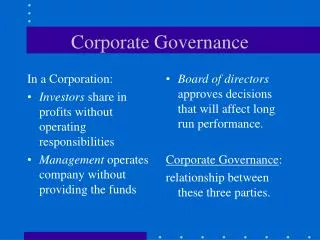
Needless to say, none of these functions are independent of the other. All occupy a pivotal position in the decision making process and naturally require coordination at the highest level. This is where corporate governance comes into play. • Empirical observations of agency theory reveal that management might act irresponsibly, or have different objectives. These may be sub-optimal relative to shareholders wealth maximization, particularly if management behavior is not monitored, or they receive inappropriate incentives.
MAIN FEATURES • Traditional • Managerial • Economic • Systematic • Behavioral • Post-Modern