Parallel Computational Geometry
This paper presents a parallel algorithm to compute the lower envelope of a set of n non-intersecting line segments in O(1) rounds. Each processor in a parallel computing environment observes O(n/p) line segments, allowing for local computation of the lower envelope LE(Si). The methodology involves locally calculating LE(Si), globally sorting the results, determining relations for each processor, and communicating segment intersections. This approach significantly enhances efficiency in processing and reduces computational complexity, making it suitable for complex geometric applications.

Parallel Computational Geometry
E N D
Presentation Transcript
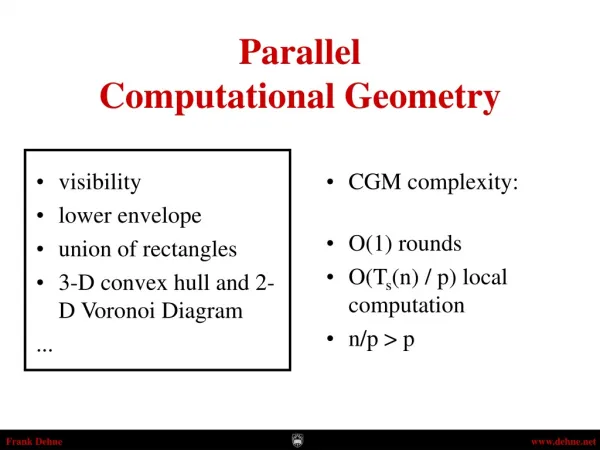
visibility lower envelope union of rectangles 3-D convex hull and 2-D Voronoi Diagram ... CGM complexity: O(1) rounds O(Ts(n) / p) local computation n/p > p ParallelComputational Geometry
Lower Envelope • Given: A set S of n non-intersecting line segments S
Lower Envelope • Given: A set S of n non-intersecting line segments S LE(S) • Task: Compute the lower envelope LE(S)
Lower Envelope • Goal: O(1) rounds • Problem: Each processor “sees” only O(n/p) line segments
Lower Envelope proc. 1 proc. 2 proc. 3 proc. 4 S1 S2 S3 S4 S = S1S2S3S4
Lower Envelope proc. 1 proc. 2 proc. 3 proc. 4 S1 S2 S3 S4 S = S1S2S3S4 • Step 1: Each proc. Pi computes locally LE(Si)
Lower Envelope proc. 1 proc. 2 proc. 3 proc. 4 S1 S2 S3 S4 S = S1S2S3S4 • Step 1: Each proc. Pi computes locally LE(Si) proc. 1 proc. 2 proc. 3 proc. 4
Lower Envelope • Step 2: Globally sort [i=1..pLE(Si)] by x-coord. of right endpoint
Lower Envelope • Step 2: Globally sort [i=1..pLE(Si)] by x-coord. of right endpoint proc. 1 proc. 2 proc. 3 proc. 4 V1 V2 V3 V4
Lower Envelope • Step 3: Each Pi determines Li and broadcasts Li to all other Pj (one h-relation) proc. 1 proc. 2 proc. 3 proc. 4 V1 V2 V3 V4 L1 L2 L3 L4
Lower Envelope • Step 4: Each Pi scans LE(Si) and sends the segment intersecting Lj to Pj for j=1..p (one h-relation) proc. 1 proc. 2 proc. 3 proc. 4 R1 R2 R3 R4 V1 V2 V3 V4 L1 L2 L3 L4
Lower Envelope • Step 5: Each Pi computes LE(Vi Ri) proc. 1 proc. 2 proc. 3 proc. 4 R1 R2 R3 R4 V1 V2 V3 V4 L1 L2 L3 L4