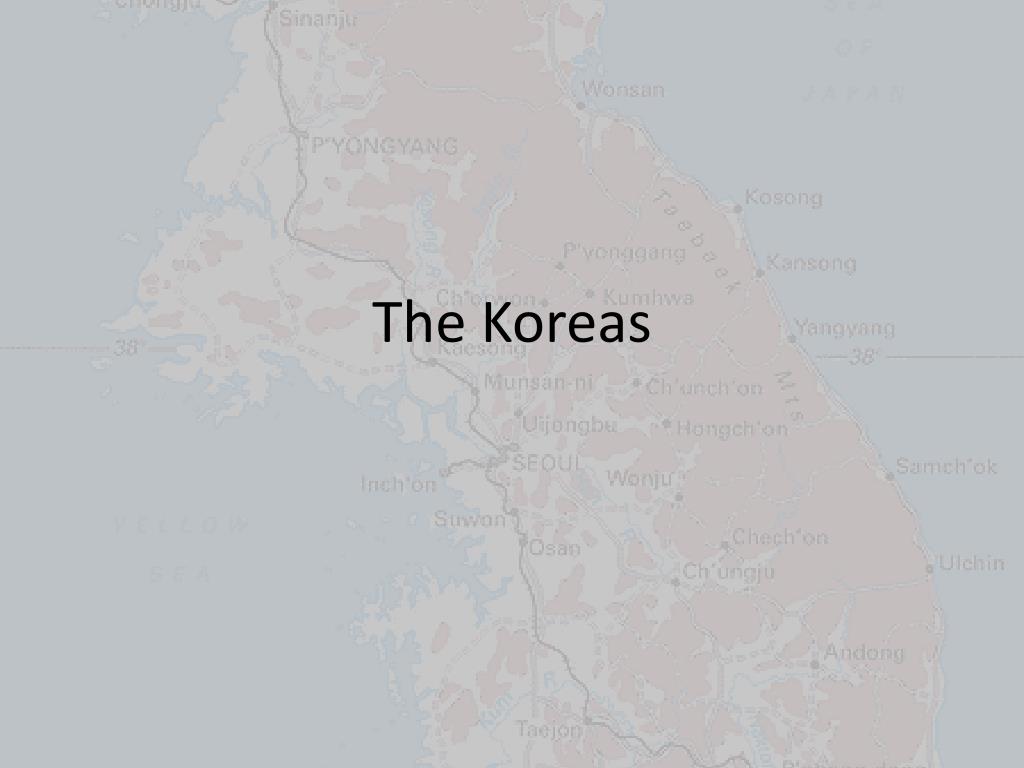
The Koreas. Geography North Korea. Find: Korea Bay - Haeju Yellow Sea - Kanggye Yulu River - Hyesan Tumen River - Najin Taedong River - Cho’ongjin Imjin River - Kinch’aek P’yongyang -Wonsan Sinuiju - Sariwon Namp’o. Geography South Korea. Find: T’aebaek Mts. -Seoul -Chonju
Une image / un lien ci-dessous est fourni (tel quel) pour télécharger la présentation
Politique de téléchargement : le contenu du site vous est fourni TEL QUEL pour votre information et votre usage personnel ; il ne peut être vendu, concédé sous licence ni partagé sur d’autres sites sans l’accord de son auteur.Le contenu vous est fourni TEL QUEL, pour votre information et votre usage personnel uniquement.Téléchargez la présentation en cliquant sur ce lien.Lors du téléchargement, si vous ne parvenez pas à télécharger une présentation, l’éditeur a peut-être supprimé le fichier de son serveur.Pendant le téléchargement, si vous ne parvenez pas à obtenir une présentation, le fichier a peut-être été supprimé par l’éditeur.
Geography North Korea • Find: • Korea Bay -Haeju • Yellow Sea -Kanggye • Yulu River -Hyesan • Tumen River -Najin • Taedong River -Cho’ongjin • Imjin River -Kinch’aek • P’yongyang -Wonsan • Sinuiju -Sariwon • Namp’o
Geography South Korea • Find: • T’aebaek Mts. -Seoul -Chonju • Sea of Japan -Kangnung -Taegu • Yellow Sea -Chuncheon -Masan • Korea Strait -Inch’on -Kwangju • Cheju Strait -Suwon -Mokp’o • Han River -Wonju -Pusan • Naktong River -Andong -Yosu • Kum River -Kunsan -P’ohang
Climate • North Korea: temperate with rainfall concentrated in the summer • South Korea: temperate, with rainfall heavier in the summer than winter
Korean War • June 25, 1950- July 1953 • North Korea invaded South Korea • Created an Armistice line at the 38th parallel • North Korea- Russia and China • South Korea- US and UN
Part of Japanese empire until WWII • South (anti-communist)- Syngman Rhee • North (communist)- Kim II Sung • Neither planned on staying separate • 10,000 killed before war began
N. Korea made first move • Outside forces believed in containment • Use military force • Step in before it goes too far
General Douglas MacArthur • In charge of Asian fights • Liberate the North from communists • Use Nationalist Chinese forces from Taiwan (Chiang Kai-shek) • Wanted to use nuclear weapons on Chinese/Korean border • President Truman fired him for insubordination
Amphibious attack on Inchon • N. Koreans from Seoul to their side • US makes it close to border • Chinese join attack • Mao Zedong sends troops to N.Korea warn US
Unified Silla Dynasty (668-935) • Originally part of three kingdoms • Silla, Paekche, Koguryo • Joined Tang China (618-907) • Conquered Paekche in SE in 660 • Conquered Koguryo in N Korea in 668
Parhae • Remaining Koguryo people in northern Manchuria • Leader: Tae Cho-yong • Age of separate southern & northern states • Chinese called it “Prosperous Country of the East” • Since conquered it has not been part of Korea
Reason for western name: Korea • Established in 918 • Leader: Wang Kon • 936 established a unified kingdom • Absorb people of overthrown states • Silla & Parhae • Expanded to Yalu River
Aristocrats continued to rule • Family lineage was very important • Maintaining or elevating social & political status was important • Families of 5th out of 9 grades did not have to take exams to receive official jobs
Government: • Two Groups: • Three Chancelleries • Royal Secretariat • Together formed the Supreme Council of State • Families above 5th grade received land for permanent possession • Land was a source of wealth
26 monarchs who ruled from 1392 to 1910 • Seoul was the capital • Confucian replaced Buddhism • Printing was developed in 1234 • Medicine • Astronomy • Geography • History • Agriculture • 1443 Phonetic Alphabet was completed
Standard of living increased • Production increased • Created own money • Changed from theory to practical relevance • Christianity was introduced in S. Korea • Christianity was banned
Isolation • Korea became isolationist • Closed ports • Close borders • Ignored foreign ideas • Mid 1800’s west wanted ports open • “Hermit Kingdom” • China supported • Unequal treaties
In 1910 Japan annexed Korea • Koreans resented their rule • Created peaceful demonstration • March 1st Movement • Japanese killed 2,000 and jailed 19,000 • Leaders fled
Japan ruled until WWII • Japan tried to diminish the Koreans • Forbade language • Take Japanese • Change last names
Government & Economics • South Korea: • Fear of invasion • Authoritarian rule • Syngman Rhee/ President Park Chung Hee • Harsh control • Stability and economic growth
Connexion au compte
Connectez-vous pour publier votre contenu sur SlideServe.