Understanding Patterns of "It" in English Sentences
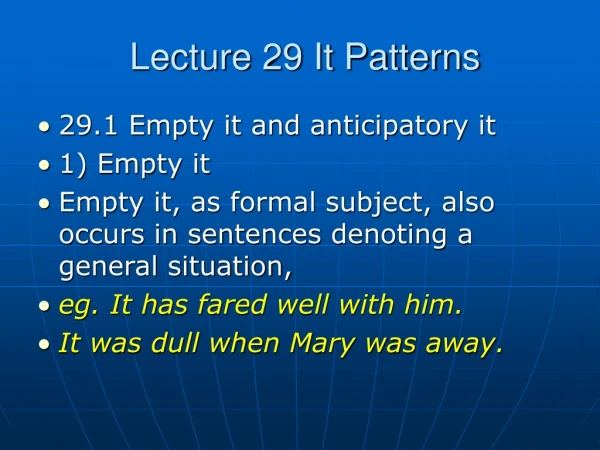
This lecture explores the use of "it" in various English sentence structures, focusing on two main types: empty "it" and anticipatory "it." The session defines how empty "it" serves as a formal subject in general situations, illustrated by examples like "It has fared well with him." and "It was dull when Mary was away." Additionally, we discuss anticipatory "it," which appears in sentences with nominal clauses, such as "It was not known whether there was gold left in the mine." The lecture also covers cleft sentences, highlighting the differences between introductory "it" and anticipatory "it."

Understanding Patterns of "It" in English Sentences
E N D
Presentation Transcript
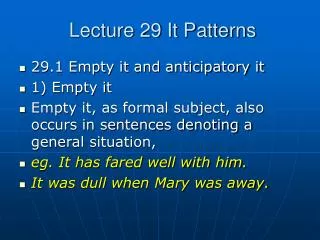
Lecture 29 It Patterns • 29.1 Empty it and anticipatory it • 1) Empty it • Empty it, as formal subject, also occurs in sentences denoting a general situation, • eg. It has fared well with him. • It was dull when Mary was away.
2) Anticipatory it • Anticipatory it commonly occurs in sentences with a nominal clause as subject or object. • Eg. It was not known whether there was gold left in the mine. • He made it clear that he didn’t want to speak to me.
29.2 It as introductory word of cleft sentences • 1) Cleft sentence defined • A cleft sentence is an emphatic construction with non-referring it as formal subject. It is also called because it is formed by dividing a single statement into two separate parts each with a verb of its own. • It + be + focal element + that/ who-clause
2) Introductory it in cleft sentences vs anticipatory it • The introductory it of a cleft sentence is functionally different from an anticipatory it: the introductory it does not stand for any extraposed subject, while an anticipatory it does. • 3) Pseudo-cleft sentences • A pesudo-cleft sentence is essentially an SVC construction with a what-clause as subject. • Eg. I gave her a handbag. • →What I did was (to) give her a handbag.