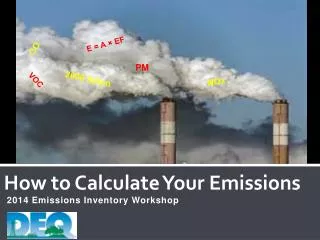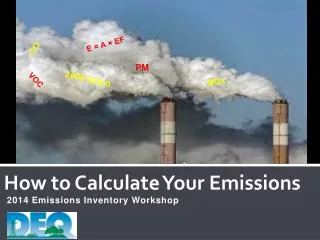
How to Calculate Your Emissions Using Activity and Emission Factors
410 likes | 574 Vues
Understanding how to accurately calculate emissions is essential for environmental compliance and sustainability efforts. This guide provides the general equation ( E = A times EF ) where ( E ) represents calculated emissions, ( A ) is the annual process activity rate, and ( EF ) is the emission factor determined by calculation methods. Examples included detail emissions from industrial boilers, engines, surface coatings, and pneumatics, emphasizing the importance of control and capture efficiencies in emission calculations.


How to Calculate Your Emissions Using Activity and Emission Factors
E N D
Presentation Transcript
How to Calculate Your Emissions E = A × EF CO PM 2000 lb/ton VOC NOx 2014 Emissions Inventory Workshop
General Equation • For most emission sources the following equation is used: • E = A * EF • Where • E = Calculated emissions • A = Activity or annual process rate • EF = Emission factor - determined by the method of calculation • Example sources: • AP-42 • WebFire • Permit 2014 Emissions Inventory Workshop
Industrial Boiler – CO Calculation Process: 10-100 mmbtu/hr boiler SCC: 10200602 Fuel: Natural Gas Capacity: 84 mmbtu/hr Control: Uncontrolled 2014 Emissions Inventory Workshop
US EPA CHIEF Website: http://www.epa.gov/ttn/chief/index.html 2014 Emissions Inventory Workshop
Industrial Boiler – CO Calculation 2014 Emissions Inventory Workshop
EF A E • E = A * EF = ??? tons Convert to tons: 2014 Emissions Inventory Workshop
Industrial Boiler – CO Calculation 2014 Emissions Inventory Workshop
Engine – Formaldehyde Calculation Process: 2 - Cycle Lean Burn Natural Gas Engine SCC: 20200252 Fuel: Natural Gas Capacity: 1100 hp Control: Uncontrolled 2014 Emissions Inventory Workshop
US EPA CHIEF Website: http://www.epa.gov/ttn/chief/index.html 2014 Emissions Inventory Workshop
EF A E • E = A * EF = ??? tons Convert to tons: 2014 Emissions Inventory Workshop
Engine – Formaldehyde Calculation 2014 Emissions Inventory Workshop
Emergency Generator – NOx Calculation Process: Reciprocating emergency generator SCC: 20200102 Fuel: Diesel Capacity: 400 hp Pollutant: NOx Factor: 604 lbs/1000 gal Control: Uncontrolled Operation: 50 hours Activity: 500 gal Heat Content: 137 mmbtu/1000 gal 2014 Emissions Inventory Workshop
EF A • E = A * EF = ??? tons E Convert to tons: 2014 Emissions Inventory Workshop
Surface Coating – Xylene/VOC Calculation Process: Surface coating – spray painting SCC: 40200101 Pollutant: Xylene, VOC (non-HAP) Paint: Acrylic Red 2014 Emissions Inventory Workshop
E = A * VOC Content * (Xylene:VOC Ratio) = ??? tons Now, for non-HAP VOC: VOC (non-HAP) = Total VOC ̶ Xylene VOC (non-HAP) = 2014 Emissions Inventory Workshop
Natural Gas Production – Pneumatic Devices Process: Pneumatic Controllers: High Bleed SCC: 31000242 Pollutant: VOC Bleed Rate: 32.1 scf/hr whole gas 2014 Emissions Inventory Workshop
E = Gas Vented * VOC Content = ??? tons = 1406 Mscf wt. % VOC Gas MW Conversion VOC = Gas Vented 19.25 = 9,284 lb 1406 Mscf VOC = VOC Emissions = 9,284 lb = 4.642 tons VOC 2014 Emissions Inventory Workshop
Control Equipment Calculations 2014 Emissions Inventory Workshop
Control Efficiency Calculations • Capture Efficiency: • The percentage of air emission that is collected and routed to the control equipment. Most control devices have a 100% capture efficiency. • Control Efficiency: • The percentage of air pollutant that is removed from the air stream by the control device. 2014 Emissions Inventory Workshop
Stone Quarry – Primary Crushing Calculation Process: Primary Crushing SCC: 30532001 Pollutant: PM10 Control: Water Spraying 2014 Emissions Inventory Workshop
Stone Quarry – Primary Crushing Calculation 2014 Emissions Inventory Workshop
EF A E • E = A * EF * (1 – Control Efficiency) = ??? tons Account for control: Convert to tons: 2014 Emissions Inventory Workshop
Two Controls – Grain Handling Calculation Process: Grain handling for feed manufacture SCC: 30200801 Activity: 10,000 tons Pollutant: PM 10 Factor: 3 lbs/ton Primary Control: Cyclone Secondary Control: Baghouse 2014 Emissions Inventory Workshop
A Complex Situation: Capture Efficiency, Primary Efficiency & Secondary Efficiency 2014 Emissions Inventory Workshop
Two Controls – Grain Handling Calculation • Capture Device: Hood • Therefore, the other 10% is emitted directly to the atmosphere • Primary control device: Cyclone • The control equipment removes 80% of PM 10 from the emission stream. • Secondary control device: Baghouse • The control equipment removes 98% of PM 10 from the emission stream. 2014 Emissions Inventory Workshop
Total E = Captured E + Uncaptured E = ??? tons Captured E = A * EF * CE * (1 – PE) * (1 – SE) Uncaptured E = A * EF * (1 – CE) 2014 Emissions Inventory Workshop
A EF • Captured E = A * EF * CE * (1 – PE) * (1 – SE) Account for capture and controls: CE SE PE 2014 Emissions Inventory Workshop
Uncaptured E = E * (1 – CE) Account for all PM 10 emissions: Convert to tons: 2014 Emissions Inventory Workshop
1 Amount to Hopper 5,400 lbs * 0.98 = 5,292 lbs 4 30,000 lbs of PM generated Amount to Hopper 27,000 lbs* 0.80 = 21,600 lbs 6 2 3,000 lbs of PM emitted “not captured” 27,000 lbs– 21,600 lbs = 5,400 lbs to the Baghouse Amount emitted to the atmosphere 5,400 lbs – 5,292 lbs = 108 lbs 108 lbs stack emissions + 3,000 lbs “not captured,” emitted as a fugitive = 3,108 lbs = 1.554 tons 5 7 27,000 lbs of PM “captured” , sent to cyclone 3 2014 Emissions Inventory Workshop
Other Examples If you would like to see an example calculation for another industry, process, or control equipment not presented today: Please email aei@deq.ok.gov and we will create an example for you. 2014 Emissions Inventory Workshop
ODEQ Emissions Inventory Section Program Manager: Mark Gibbs Mark.Gibbs@deq.ok.gov Emissions Inventory Staff: Cooper Garbe Cooper.Garbe@deq.ok.gov Cody Lathrop Cody.Lathrop@deq.ok.gov Michelle Horn Michelle.Horn@deq.ok.gov Justin Milton Justin.Milton@deq.ok.gov Carrie Schroeder Carrie.Schroeder@deq.ok.gov http://www.deq.state.ok.us/aqdnew/emissions/index.htm 2014 Emissions Inventory Workshop