TPCASTT
TPCASTT. Effectively Analyzing Poetry in the Classroom. TPCASTT. We use TPCASTT to help us analyze poetry. It is designed to help you remember the concepts when you are analyzing a poem. (T) i tle. We begin by making an inference. An inference is:

TPCASTT
E N D
Presentation Transcript
TPCASTT Effectively Analyzing Poetry in the Classroom
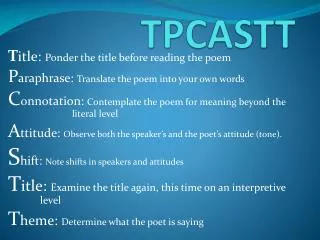
TPCASTT • We use TPCASTT to help us analyze poetry. • It is designed to help you remember the concepts when you are analyzing a poem.
(T)itle • We begin by making an inference. • An inference is: • A conclusion reached on the basis of evidence and reasoning. • This means that we do not just make an assumption but we look for evidence as to why the title is what it is. • We look at the title of the poem and ask: • What might this poem be about? • Is there anything significant about this title? • Does the title have a double meaning?
(P)araphrase • Paraphrasing: • Using your own words you explain what the poem is about. • You should do this in 2-3 sentences. • However, longer poems may require that you paraphrase/summarize each stanza.
(C)onnotation • We use connotation to determine the mood, tone, imagery, figurative language, allusions, symbolism, diction, point of view, and sound devices used in a poem. • These are all important elements of poetry and thus should be analyzed thoroughly.
(A)ttitude • What do you think the author sounds like? • Is he angry, preachy, in love, happy, melancholy, frustrated, or trying to invoke social change? • An author’s attitude can tell us a lot about the poems meaning.
(S)hift • We see the shift when the author makes a sudden change. • Poems rarely start and finish in the same place. • In other words the tone or mood will change. • You can see this through punctuation, stanza divisions, rhyme scheme, or keywords
(T)itle • We need to reexamine the title. • Ask yourself if you have changed your mind about the title? Do you have a new idea about its meaning? • Does the poem have two meanings? • Can you identify both meanings? • Maybe a new meaning developed as you read the poem.
(T)heme • Now that we have read the whole poem we need to determine the theme • Theme is different than Attitude. • What is the human experience, motivation, or condition that the author is suggesting. • Look at the literal and abstract concepts within the poem. • Think war, death, love, friendship, etc.