Whole Brain Teaching
Whole Brain Teaching (WBT), initiated in 1999 by California educators, aims to revolutionize classroom environments through engaging management strategies and teaching methods. WBT promotes orderly fun and active learning, utilizing techniques like class rules, scoreboard systems, and multisensory approaches. While some educators applaud its effectiveness in fostering engagement, concerns regarding its research basis and potential superficial learning persist. This overview discusses WBT’s framework, benefits, and cautions, encouraging teachers to explore its methods and adapt them to their unique classroom needs.

Whole Brain Teaching
E N D
Presentation Transcript
Whole Brain Teaching Katie DeFazio & Ashley Kelly
Origin of WBT • Began in 1999 by three teachers from California: Chris Biffle, Jay Vanderfin, and Chris Rekstad • Claim to be one of the fastest growing, education reform movements in America • Goal: Create peaceful classrooms full of orderly fun
What is WBT? • Class Rules • Management System • Engaging teaching methods
Class Rules • Follow directions quickly • Raise your hand for permission to speak • Raise your hand for permission to leave your seat • Make smart choices • Keep your dear teacher happy
Classroom Management • Levels • The Scoreboard • Practice Cards • Guff Counter • Independents • Bull’s Eye Game • The Agreement Bridge
Engaging Teaching Methods • Class – Yes • Teach – OK • Hands and eyes • Mirror • Switch
Benefits of WBT • Active engagement and learning • Elaborative rehearsal • Simultaneous multisensory learning • Create pathways to long-term storage
Concerns About WBT • Is it just a fad? • Not research based • Misleading claims • Brain claims • Effective problem solving strategies?
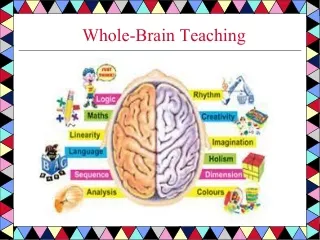
What should you be aware of? • Little to no research to support effectiveness • Pre-teaching required • A potential for robot-like students • Surface level vs. deep learning • Neuromyths • Left vs. Right Brain Learning • Using all 4 hemispheres Creative Analytical Emotional Organized
Our Recommendations • WBT provides an effective framework • Teaching aids • Classroom exercises • Classroom rules and structure • Engaging learning opportunities for students • Success alongside supplemental strategies • Interested? Do your research. You are a professional. Do what you know is best practice for your students.
Resources • Biffle, C. (2013). Whole brain teaching for challenging kids. Lucinda Geist. Retrieved from http://www.sammt.org/cms/lib03/MT15000278/Centricity/Domain/56/WholeBrain_Biffle.pdf • Biffle, C. (2013). Whole brain teachers of america. Retrieved from http://www.wholebrainteaching.com/index.php?option=com_k2&view=item&layout=item&id=135&Itemid=105 • Bonnema, T. (2009). Enhancing student learning with brain-based research. • Cassidy, D. J. (n.d.). A brief introduction to "whole-brain" teaching and learning. (Master's thesis, UMUC)Retrieved from http://peoplelearn.homestead.com/MEdHOME2/Leadership/Cassidy_Whole-Brain_Presentation.pdf • Connell, D. (2013). Left brain vs right brain in the classroom. Scholastic, Retrieved from http://www.scholastic.com/teachers/article/left-brainright-brain • Fishel, J. (2011). [Web log message]. Retrieved from http://jessiefishel.weebly.com/whole-brain-teaching-research.html • Forsythe, J. (2013, April 6). How effective is 'whole brain teaching'?. Retrieved from http://www.bnd.com/2013/04/06/2566812/how-effective-is-whole-brain-teaching.html
Resources Continued • Freundlichteaching. (Performer) (2010). Whole brain teaching: Grade 1 classroom [Web]. Retrieved from http://www.youtube.com/watch?v=aaweXw03kQI • Medina, J. (2008). Brain Rules: 9 Sensory Integration. (1st ed., pp. 199-218). Seattle, WA: Pear Press. • Lepper, L. (2011, April 30). Three basic techniques in whole brain teaching. Retrieved from http://www.ajarn.com/blogs/lee-lepper/three-basic-techniques-in-whole-brain-teaching/ • Smith, C. V., & Cardaciotto, L. (2011). Is active learning like broccoli? student perceptions of active learning in large lecture classes. Journal of the Scholarship of Teaching and Learning, 11(1), 53-61. Retrieved from www.iupui.edu/~josotl • Stephanie. (2012, July 19). [Web log message]. Retrieved from http://www.3rdgradethoughts.com/2012/07/getting-started-with-whole-brain.html • Wolfe, P. (2010). Brain Matters. (2nd ed., pp.149-151). Arlington, VA: ASCD.