Understanding the Elements of Design: Line, Colour, Texture, Value, Shape, Form, and Space
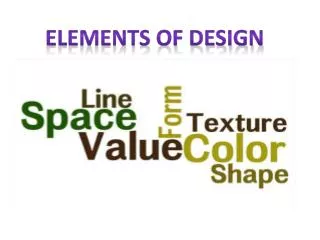
This comprehensive guide explores the fundamental elements of design, including line, colour, texture, value, shape, form, and space. Each element is defined and explained, detailing its unique properties and significance. The concept of line is illustrated through its variations in length, width, texture, direction, and curvature. Colour is analyzed through its properties of hue, value, and intensity. Texture describes the tactile quality of surfaces, while value indicates lightness or darkness. Shape and form address two and three-dimensional areas, respectively. Finally, space encompasses the emptiness surrounding elements.

Understanding the Elements of Design: Line, Colour, Texture, Value, Shape, Form, and Space
E N D
Presentation Transcript
The Elements of Design Mrs. Liboiron Media 2013
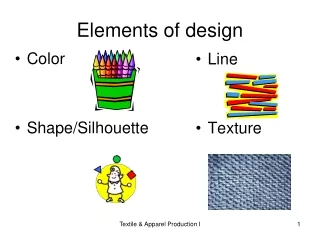
The Elements of Design Line Colour Texture Value Shape/Form Space
Line • A mark drawn with a pointed, moving tool or object • Lines have different: • lengths • Widths • Textures • Directions • degrees of curve
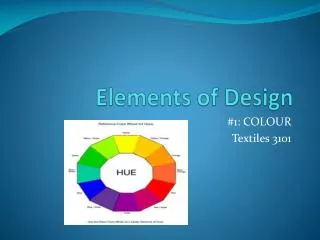
Colour • Colour is an element of design that is derived from reflected light • Colour has three properties: • Hue • Value • Intensity
Properties of Colour Hue: the name of a colour. The primary hues are red, yellow and blue. Value: refers to the lightness or darkness of an object. Intensity: refers to the brightness and dullness of a colour.
Hue, Value & Intensity Hue: Value: Intensity:
Texture Texture is the element of design that refers to how things feel, or look as if they might feel if touched. Texture can be hard, soft, rough, smooth, slippery, sticky, scratchy, etc.
Value Value is the element of design that refers to lightness or darkness. Value helps to define the shapes of objects in an image by showing the viewer what the light is doing.
Shape Shape is a two dimensional area that is defined in some way. It can be defined through line, colour, or value. Shape has only height and width.
Form Form is the element of design that includes objects that have three dimensions. Form has height, width and depth.
Space Space, also known as negative space, is the element of design that refers to the emptiness or area between, around, below or within objects. Shapes are defined by the space around and within them.