Download
1 / 21
210 likes | 403 Vues
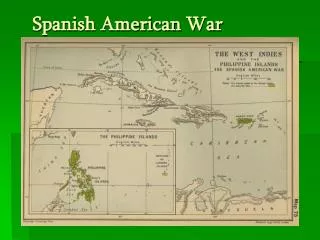
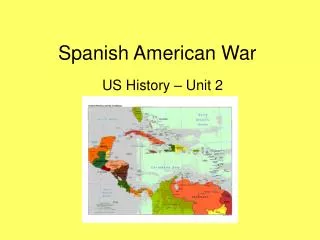
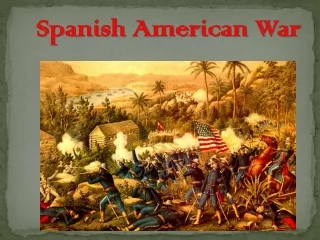
The Spanish-American War highlights U.S. ambitions in Cuba from the mid-19th century. Key figures like William L. Marcy and James Buchanan advocated for the acquisition of Cuba, viewing it as a potential asset for American prosperity. The conflict intensified with media sensationalism from publishers like Hearst and Pulitzer, who influenced public opinion. Events like the sinking of the USS Maine and the actions of General Weyler galvanized American support for intervention. This era reshaped Cuba's future and U.S. foreign policy in the Caribbean.

E N D
Spanish American War Deal or No Deal
William L. Marcy, US Secretary of State (1853-1857) “Our minister at Madrid, during the Administration of President Polk, was instructed to ascertain if Spain was disposed to transfer Cuba to the United States for a liberal pecuniary consideration.” July 23, 1853
James Buchanan, 15th President (1857-1861) “I reiterate [my] recommendation ... in favor of the acquisition of Cuba from Spain by fair purchase. I firmly believe that such an acquisition would contribute essentially to the well-being and prosperity of both countries in all future time.” State of the Union December 3, 1860
Argued for: • Building the Panama Canal • Obtaining bases in the Caribbean • Building maritime commerce • Building a navy to protect commerce and prevent blockade • Obtaining overseas colonies for refueling and repair
Jose Marti (1853-1895) Exiled Cuban Nationalist • Published newspaper La Patria Libre (Free Fatherland) in 1869 • Arrested and sentenced to six year hard labor; released and exiled from Cuba • Founded the Cuban Revolutionary Party • Killed in a skirmish in Cuba
William Randolph Hearst Publisher, New York Journal & San Francisco Examiner • Didn't mind fabricating stories - goal was 1 million subscribers. • “You furnish the pictures, I'll furnish the war” • Published pictures showing how Spanish saboteurs had fastened an underwater mine to the Maine
Joseph Pulitzer (1847-1911)Publisher, New York World & St. Louis Post-Dispatch • At thirty-six, purchased the New York World • Sent divers to investigate the wreck of the Maine • Battled for readers with William Randolph Hearst • Endowed the school of journalism at Columbia University in New York City
General Valeriano Weyler y NicolauGovernor & Commander-in-Chief,Spanish Army in Cuba “The Butcher” • Relocated (herded) more than 300,000 rebels into "reconcentration camps, • Bad and inadequate food and lack of sanitation killed thousands of peasants • ~50,000 in Havana province alone • Cuban émigrés publicized Weyler's inhumanity and won the sympathy in the U.S.
Theodore RooseveltAssistant Secretary of the Navy • The Naval War of 1812, set the standard for studies on naval strategy and was required reading at the Naval Academy • Befriended Alfred Thayer Mahan "the liveliest spot in Washington...is the Navy Department. The decks are cleared for action. Acting Secretary Roosevelt....has the whole Navy bordering on a war footing.” New York Sun
DeLome Letter • Written by the Spanish Ambassador to the United States • Criticized President McKinley: • “weak and a bidder for the admiration of the crowd” • “a would-be politician” • Published in the New York Journal - helped generate public support for a war with Spain
Commodore George Dewey sank the entire Spanish squadron in six hours in Manila Bay, the Philippines Islands. "You may fire when your are ready, Gridley"
Platt Amendment • Approved May 22, 1903 • U.S. - Cuba Treaty: attempted to protect Cuba's independence from foreign intervention • Permitted extensive U.S. involvement in Cuban international and domestic affairs to enforce Cuban independence
Roosevelt Corollary to the Monroe Doctrine • All that this country desires is to see the neighboring countries stable, orderly and prosperous....Chronic wrongdoing, or an impotence which results in a general loosening of the ties of civilized society, may in America, as elsewhere, ultimately require intervention...[and] force the United States, however reluctantly, in flagrant cases of such wrongdoing or impotence, to the exercise of an internal police power. “Speak softly and carry a big stick”
Bibliography • http://www.spanamwar.com • http://www.ourdocuments.gov • http://www.loc.gov/rr/hispanic/ • http://www.historyofcuba.com/ • http://www.smplanet.com/imperialism/remember.html • http://www.zpub.com/cpp/saw.html • http://millercenter.org/scripps/archive/speeches • http://www.digitalhistory.uh.edu/ • http://www.encyclopedia.com/doc • http://thebsreport.wordpress.com/2009/06/12/quote-of-the-day-theodore-roosevelt/
Spanish American War Deal or No Deal