Download
1 / 19
190 likes | 301 Vues
This document explores the concept of participatory architecture within organizational contexts, focusing on education and democracy. It discusses the shift from reactive to proactive approaches in fostering participation, integrating learner-generated contexts, and addressing 21st-century challenges. The analysis emphasizes the significance of inclusive education, collaborative practices, and the role of communities in shaping their futures. It poses critical questions about the nature of participation and suggests pathways for achieving greater engagement and empowerment in educational and democratic processes.

E N D
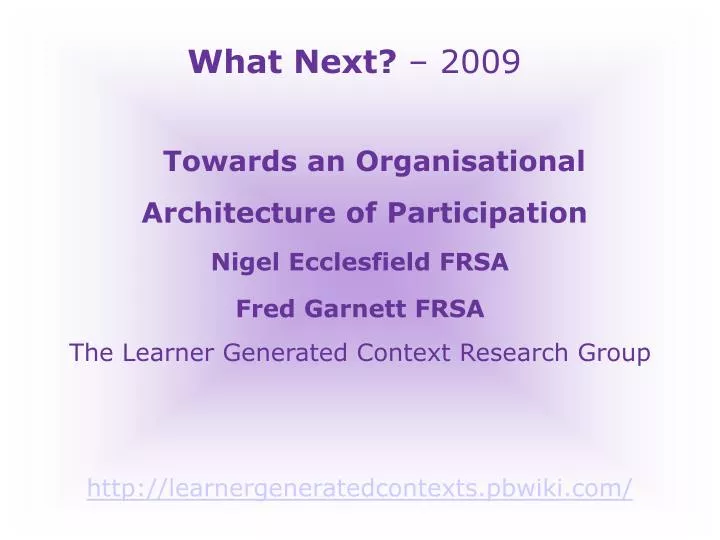
What Next? – 2009 Towards an Organisational Architecture of Participation Nigel Ecclesfield FRSA Fred Garnett FRSA The Learner Generated Context Research Group http://learnergeneratedcontexts.pbwiki.com/
Towards anOrganisational Architecture of Participation What NEXT? Education as participation
Towards anOrganisational Architecture of Participation Reactive or Pro-Active?
Towards anOrganisational Architecture of Participation Reactive; Consumer(ism)-driven Pro-Active; Citizen-Generated
Towards anOrganisational Architecture of Participation Reactive; National Curriculum Pro-Active; Learner-Generated
Towards anOrganisational Architecture of Participation Reactive; Pedagogic – better teachers Pro-Active; Heutagogic – new forms
Towards anOrganisational Architecture of Participation Reactive; Singular & Monolithic Pro-Active; Agile-Configuration
Towards anOrganisational Architecture of Participation Reactive; Managerial Leaders Pro-Active; Coincidence of Motivations
Towards anOrganisational Architecture of Participation Reactive; Privileged 'A-Level Studentson Steroids' Pro-Active; Socially Inclusive
Towards anOrganisational Architecture of Participation Reactive; Re-creating the 19th and 20th Centuries Pro-Active; Solving 21st Century Problems
Towards anOrganisational Architecture of Participation Reactive; Representative Democracy enabling Financial Capitalism and disempowering communities
Towards anOrganisational Architecture of Participation Pro-Active; Participatory Democracy enabling Local Communities
Towards anOrganisational Architecture of Participation Pro-Active; Creative, Interactive Participative Collaborative
Towards anOrganisational Architecture of Participation Pro-Active; What NEXT? Participative Education!
Towards anOrganisational Architecture of Participation Pro-Active; What NEXT? Participative Democracy!
Towards anOrganisational Architecture of Participation Q What Do We Want? A Participation! Q when do we want it A NOW!!
Towards anOrganisational Architecture of Participation Participation NOW!!
Towards anOrganisational Architecture of Participation “The Future is already here. It is just unevenly distributed” (William Gibson)
Towards anOrganisational Architecture of Participation “The Answers are already here; We are just asking the wrong Questions...” http://learnergeneratedcontexts.ning.com/