Understanding French Adjectives: Describing Nouns in French
180 likes | 312 Vues
In this lesson, we explore French adjectives and how they modify nouns. Learn to describe people and objects using various adjectives, such as *grosse* (fat), *amusant* (funny), *intelligent* (smart), and *gentil* (kind). Discover the rules for gender agreement and pluralization, where adjectives typically follow the nouns they describe. This guide emphasizes common mistakes and typical rules, assisting you in forming sentences correctly. By the end, you will better understand how to articulate descriptions effectively.


Understanding French Adjectives: Describing Nouns in French
E N D
Presentation Transcript
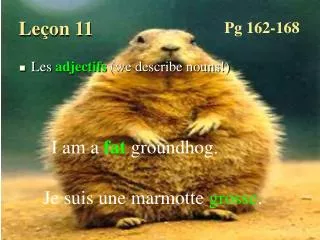
Leçon 11 Pg 162-168 • Les adjectifs(we describe nouns!) I am a fat groundhog. Je suis une marmotte grosse.
Fun or amusing amusant amusant <am u sah> Le chat est amusant. NOTES e • <am u sant> La fille est amusante.
intellegent intellegent intellegent <in tell eh zjen> Le garçon est intellegent. NOTES e • <in tell eh zjent> Mélanie est intellegente.
interesting intéressant intéressant <in tare eh sah> Marco est intéressant. NOTES e • <in tare eh sant> Margeaux est intéressante.
Mean or nasty attitude méchant méchant <may shaw> Mon frére est méchant. NOTES e • <may sawnt> Ma copine est méchante.
Silly or dumb bêt bêt <bet> Il est bête. NOTES e e • <bet> Elle est bête.
Nice or pleasant sympathiqu sympathiqu <simp a teek> M. Beauchamp est sympathique. NOTES e e • <simp a teek> Mlle. Blanchard est sympathique
Timid or shy timid timid <ti meed> L’homme est timide. NOTES e e • <ti meed> La dame est timide.
Nice or kind gentil gentil <zjahn tee> L’homme est gentil. NOTES le • <zjahn teeyuh> La dame est gentille.
Cute mignon mignon <meen yoh> Le garçon est mignon. NOTES ne • <meen yohn> La fille est mignonne.
athletic sportif sporti <spohr teef> remember CaReFuL Il est sportif. NOTES ve • <spohr teev> Elle est sportive.
You will notice a few trends: NOTES • For most adjectives, you add and –e to the end of the masculine version to get the feminine. • Adjectives that already end in an –e do not change. • Some adjectives, like those ending in “n” or “l”, get double letters added with the –e: • Gentil gentille • mignon mignonne • When an adjective ends with an “f” it changes to “ive” in the femine form: • Sportif sportive • If your subject is plural, you’ll need to add an “s” to your adjective
NOTES Masculine Feminine
americaine espangole japonaise mexicaine suisse* chinoise françcaise italienne** anglaise canadienne**
NOTES In French, Adjectives usually come AFTER the noun the describe…