Download
1 / 6
60 likes | 165 Vues
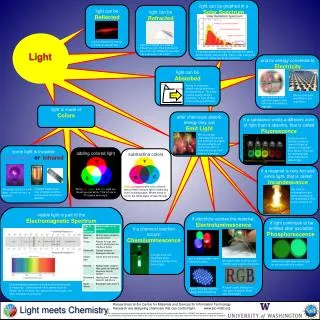
This presentation delves into the intriguing processes that occur when a molecule absorbs light. We examine four key fates of absorbed light: 1) Internal Conversion - a non-radiative process where energy is dissipated as heat; 2) Intersystem Crossing - a transition between different spin states leading to different emission properties; 3) Fluorescence - the quick re-emission of light; 4) Phosphorescence - a delayed light emission due to energy trapped in triplet states. Join us to uncover the complexities of molecular photophysics.

E N D
WHAT HAPPENS WHEN A MOLECULE ABSORBS LIGHT? 4 different fates of absorbed light are presented in the next slides 1) INTERNAL CONVERSION 2) INTERSYSTEM CROSSING 3) FLUORESCENCE 4) PHOSPHORESCENCE