Download
1 / 47
470 likes | 608 Vues
This educational overview explores the nature of light and radiation from the Sun, detailing the various forms of electromagnetic radiation and their properties. It explains how energy travels in waves and introduces the electromagnetic spectrum, which includes radiowaves, microwaves, infrared radiation, visible light, ultraviolet radiation, X-rays, and gamma rays. The text also covers the behavior of visible light, reflections, and how we perceive colors. Engaging activities like observing prisms and the characteristics of lenses are included to enhance understanding.

E N D
The Sun • The sun is a star (made of gas). • Many explosions happen on the sun (like atomic bombs) that create energy. • This energy (called radiation) travels in all directions.
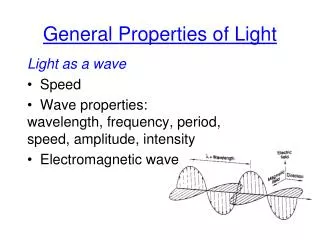
How Does Energy Travel? • Energy travels in waves (like water). • The close waves are STRONG. • Waves that are far away are WEAK.
Electromagnetic Radiation • The sun is so powerful that it creates 7 different kinds of radiation. • Some of this radiation is strong (waves close together); some of it is weak (waves far apart). • All the different kinds of radiation is organized in an Electromagnetic Spectrum.
Electromagnetic Spectrum • There are 7 kinds of radiation in the electromagnetic spectrum: • Radiowaves, Microwaves, Infrared Radiation, Visible Light, Ultraviolet Radiation, X-Rays, and Gamma Rays.
Type this the address bar. Be careful to type it correctly. http://school.discovery.com/lessonplans/activities/electromagneticspectrum/
The Electromagnetic Spectrum • Radiowaves – weak waves that give your radio or TV the energy to work. (can you see them?) • Microwaves - weak waves that can cook your food or used for cell phones and radar. (can you see them?) • Infrared Radiation – weak waves coming from something that is hot. (can you see them?) • Visible Light – the only radiation you can see.
Continued… • Ultraviolet Radiation – strong radiation that can make you tan and get cancer. (Can you see them?) • X-Rays – dangerous radiation that can go through to your bones. (can you see them?) • Gamma rays - the most powerful radiation. Very dangerous. Found in a nuclear explosion.
Electromagnetic Spectrum Book(This is your homework, check for due date)
Visible Light • Humans can only see visible light. • Visible light is made up of all of the colors of the rainbow: • Red • Orange • Yellow • Green • Blue • Indigo • Violet
How visible light travels… • Visible Light travels in waves… • BUT, the waves are so small that from far away it looks like a straight line. • SO…from now on we will ONLY say that light travels in a straight line.
Does light travel in a straight line FOREVER? • Light travels in a straight line ONLY if travels through the same stuff (like air or water). • Otherwise…if light strikes an object, then it changes direction and is not straight anymore.
Light Does 4 Things When it Hits an Object: • Reflection • Transmittance • Absorption • Refraction
4 things can happen when light hits an object: Reflection Absorption Transmittance Refraction
How are the 2 angles related? • The angle of incidence and the angle of reflection are ALWAYS the same!!!
Where does visible light come from? • Very, very hot things create and radiate light.
How are you able to see the moon? • The moon is cold. • It does not make light. • It looks white because the sun makes light which reflects off of the moon and goes to our eyes.
Remember: • The colors of the rainbow are: • Red, Orange, Yellow, Green, Blue, Indigo, and Violet. • All the colors of the rainbow are ROY G. BIV.
Prisms • What did you notice when the light hit the prisms??? • The reason a rainbow appeared is because the light was... REFRACTED.
Visible Light • Each color of the rainbow has a different size wave. • Some colors are stronger than others • Red is weakest • Violet is strongest.
Visible Light • What does this say about white light (visible light)? • VISIBLE LIGHT (white light) IS MADE UP OF ALL COLORS OF THE RAINBOW!!!!!
Colors • White light is hitting the apple. • Every color of the rainbow is being absorbed by the apple EXCEPT the color red. • The red light that is reflected bounces to your eyes and you see red.
Lenses • A lens is a clear object that refracts light so that you can see a bigger version of an object.
What kind of lens would you use… • 1. To see your fingerprint up close? • 2. To see a bird that is 20 feet away? • 3. To see the planet Mars? • 4. To see a tiny bacterial cell?
Why do things look upside down when you hold the lens far away?
LIGHT TEST • The following vocabulary words will appear on your test: • Radiation • Electromagnetic spectrum • Radio waves, Microwaves, Infrared Radiation, Visible Light, Ultraviolet Radiation, X-Rays, Gamma Rays • Reflection, Refraction, Absorption, Transmittance • Angle of Incidence & Angle of Reflection • White Light • ROY G. BIV • Prism • Lens • Microscope, Magnifying Lens, Binoculars, Telescope
LIGHT TEST • In order to pass, you must know the following: • What is the electromagnetic spectrum and how much is visible to humans? • How does visible light appear to travel? • What 4 things can happen when visible light hits an object? • How are the angle of incidence and angle of reflection related? • How are humans able to see objects? • Why are objects a certain color? • Which kind of lens would you use to see different sized things? • How does a magnifying lens work?