Understanding "Like" and "As" in Comparisons and Examples
This guide explains the usage of "like" and "as" in English, focusing on their role in making comparisons and providing examples. Learn how "like" indicates similarity and is used in informal comparisons, while "as" is typically used in more formal contexts, often followed by a verb. Discover practical examples of each, along with tips for completing sentences correctly. By mastering these two expressions, you'll enhance your English communication skills and avoid common pitfalls when describing similarities or giving examples.

Understanding "Like" and "As" in Comparisons and Examples
E N D
Presentation Transcript
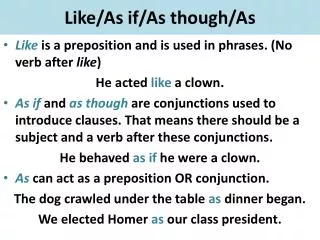
like and as • Like = similar to / the same as / for example: What a beautiful house! It’s like a palace. “What does George do?” “He’s a teacher like me.” Why do you always talk about boring things like your job? Be careful the floor is wet. It’s like walking on ice.
We use as before a subject + verb • Don’t move anything. Leave everything as it is. • Compare: You should have done it like this. You should have done it as I showed you. • But we use such as (=for example) without a verb: Some sports, such as car racing, can be dangerous.
other expressions with as • He’s late as usual. • As you know, it’s Tom’s birthday today. • She failed the test, as we expected.
Compare like and as: • She looks beautiful – like a princess. (she isn’t really a princess) • Everyone is ill. Our house is like a hospital. (it isn’t really a hospital) • A few years ago I worked as a busdriver. (I really was a busdriver) • During the war the hotel was used as a hospital. (so it really was a hospital)
Complete the sentences with like or as. • Do you think Ann looks ___ her mother? • We have an extra bedroom which we use ___ a study. • He really annoys me. I can’t stand people ___ him. • I’ll phone you tomorrow ___ usual. • Your English is very fluent. I wish I could speak ___ you. • He gave up his job ___ a journalist to spend more time with the family. • We haven’t got a car so we use the garage ___ a workshop.