Download
1 / 18
180 likes | 287 Vues
This study examines the current conditions and potential enhancements for fish habitat in Dry Creek, focusing on coho salmon and steelhead trout populations. It includes watershed history, stream geomorphology, fish habitat inventory, and opportunities for enhancement projects.

E N D
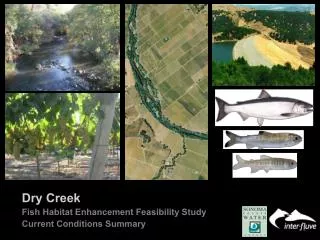
Dry Creek Fish Habitat Enhancement Feasibility StudyCurrent Conditions Summary
Dry Creek Fish Habitat Enhancement-Component of Russian River Instream Flow and Restoration (Biological Opinion)- Habitat enhancement for coho salmon and steelhead trout- Opportunity: abundant cool water in late summer
Habitat Enhancement Feasibility Study-Two Study Phases1) Inventory of Current Conditions▪ Watershed Characteristics/History▪ Stream Geomorphology Today▪ Fish Habitat 2) Feasibility Analysis and Conceptual Design
Watershed Characteristics-217 sq. mi. (130 sq. mi. upstream of Warm Springs Dam)- Largest tributary to Russian River based on annual runoff- Creek flow pattern pre-Warm Springs Dam ▪ Typical of Mediterranean Climate ▪ High floods resulting from winter rainstorms ▪ Very low flow (dry in many years) in summer
Watershed History1850s: Valley settled▪ 40% of forested acres cleared 1850-1870 ▪ Increased runoff and sediment to lower valley ▪ These actions initially raised creek bed (3’) ▪ Vegetation recovery resulted in creek bed lowering by turn of century (4’) 1900 – 1970s: Gravel mining in Russian River 1950s -1970s: Gravel mining in Dry Creek near Westside Br. 1952: Healdsburg Dam 1959: Coyote Dam▪ Combined influences resulted in additional creek bed lowering by (10’) ▪ Lowering of stream propagated up Dry Creek tributaries ▪ Effects slowed by mid-1980s
Watershed History Creek changes 1850 -1980s Vineyard level 1850 Vineyard level Vineyard level Pre dam conditions
Watershed History Creek changes 1984 – Today1984: Closure of Warm Springs Dam▪ flow patterns ▪ sediment patterns ▪ vegetation patterns
Stream Geomorphology TodayFlow patterns:▪ reduced winter floods ▪ higher summer flowsSediment patterns:▪ cut off upper 60% of watershed ▪ moderated by supply from Pena, Dutcher, Crane, Mill Creeks
Stream Geomorphology TodayVegetation patterns:▪ combination of reduced winter floods and high summer flows resulted in extensive riparian growth ▪ stabilizes gravel bars ▪ focuses flow in channel
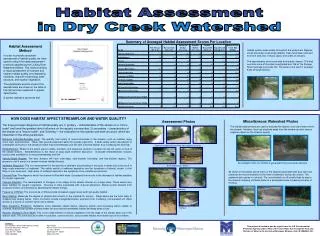
Fish HabitatInventory of 13.9 miles between WS dam and Russian River:▪ Pools ▪ Riffles ▪ Glides ▪ Alcove and edge habitat
Fish HabitatInventory of 13.9 miles between WS dam and Russian River: ▪ Measured depths, widths, areas, cover, complexity, creek bed material, woody material▪ Created maps for each segment of study reach (16 sub-reaches)
Fish HabitatSelected Results (substrate and woody material):▪ Riffles had 80% of their gravels in target range for spawning ▪ Fine sediment in riffles low (<10%) ▪ Average of 209 pieces of woody debris per mile (pools, scour pools) ▪ 46% of woody debris pieces were living ▪ Alcoves most prevalent in lower half of study reach ▪ Edge habitat slightly more prevalent in lower half ▪ Overall habitat quality less than ideal, e.g., velocity
Opportunities for Fish Habitat EnhancementAreas of interest for potential habitat enhancement identified ▪ Abundant opportunities for enhancement of pools, riffles, stream banks and creation of off-channel habitats ▪ All areas of interest within historic channel
Opportunities for Fish Habitat EnhancementPotential enhancement applications ▪ Riffles – supplement gravel to increase area ▪ Pools – add/re-arrange woody materials to increase cover and complexity
Opportunities for Fish Habitat EnhancementPotential enhancement applications▪ Off-channel and alcove habitat creation Before After After
Opportunities for Fish Habitat EnhancementPotential enhancement applications ▪ Stream banks – stabilization to enhance cover and complexity Dry Creek After Before
Next StepsDetailed Feasibility Analysis and Concept Designs ▪ System-scale feasibility ▪ Project-scale feasibilityUpcoming Schedule ▪ Spring – summer 2010: Detailed feasibility analysis ▪ Fall 2010: Concept designs and ranking of opportunities ▪ Summer 2011: Pilot project implementation
Questions?Dry CreekFish Habitat Enhancement Feasibility StudyCurrent Conditions Summary