
Electrolytic Cells
E N D
Presentation Transcript
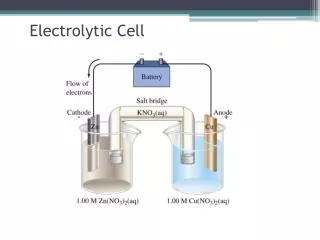
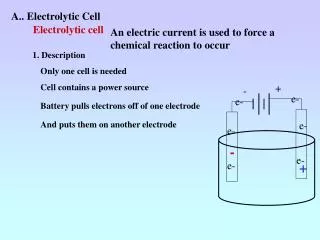
Electrolytic Cells • Is a Galvanic Cell forced to operate in reverse • Process is called electrolysis • This occurs if a voltage greater than that produced by the galvanic cell is applied to it • Electron flow is forced to operate in reverse • Reactions in each half cell will be reversed
Applications of Electrolysis • Electroplating • Plating of a thin layer of a metal on another metal to prevent corrosion or improve appearance • Extraction of Reactive Metals • Such as Sodium or Aluminium from their ores • Industrial Production • Sodium hydroxide, chlorine , hydrogen
Applications of Electrolysis • Recharging of Secondary Cells • Car batteries and NiCads Increasing the thickness of the surface oxide layer of aluminium metal
Anode and Cathode • OXIDATION always occurs at the ANODE • REDUCTION always occurs at the CATHODE • In electrolytic cell, the polarity is decided by the way the external voltage is applied.
Anode and Cathode • Positive terminal makes the electrode it is attached to the ANODE, where oxidation occurs • Negative terminal makes the electrode it is attached to the CATHODE, where reduction occurs
Electroplating • A metal is coated with another to improve • Appearance • Durability • Resistance to Corrosion • Metal to be plated is connected to Negative electrode • Dipped in solution of ions of coating metal
Electroplating • Examples • Silver • Steel cutlery to make it more decorative and to prevent rusting • Chromium • Taps, tools and car parts to make them harder • Tin • Steel food containers to prevent contaminating food
Electroplating Cr3+(aq) + 3e- Cr(s) Cr(s) Cr3+(aq) + 3e- Anode + – Cathode Object to be Coated with Chromium Pure chromium electrode Solution of Chromium Ions
Electrowinning • Metals in Groups I and II as well as Aluminium are so easily oxidised their ores cannot be reduced by the usual chemical means. • The Halogens are strong oxidants and as such are difficult to obtain as pure gases
Electrowinning • In an electrolytic cell, reduction always occurs at the negative electrode and oxidation at the positive electrode • Hence these cells can be used to produce metals and the halogens from their ores.
Electrowinning • Because water is more easily readily reduced than these metal ions and more readily oxidised than the halogens these reactions cannot occur in aqueous solutions • Despite the expense, these elements can only be obtained by using their molten salts as electrolytes in electrolytic cells • Downs Cell is used to produce sodium and chloride
Downs Cell • Downs Cell is used to produce sodium and chloride Sodium chloride added Chlorine gas Cylindrical Iron cathode Sodium metal + + – Carbon ANODE Molten sodium chloride Mixed with calcium chloride
Downs Cell • Oxidation Reaction ANODE (–) • 2Cl –(l) Cl2(g) + 2e – • Reduction Reaction CATHODE (+) • Na+(l) + e– Na (l) • Overall Reaction • 2Cl –(l) +Na+(l) Cl2(g) + Na(l)
Recharging Secondary Cells • The reactions which deliver the energy in secondary cells are reversed when the cells are recharged. • The overall reactions in each cell in a car battery are
Recharging Secondary Cells • When Discharging • Pb (s) + PbO2(s) + 2 SO42 –(aq) + 4H+ • 2PbSO4(s) + 2H2O (l) • When Recharging • 2PbSO4(s) + 2H2O (l) • Pb (s) + PbO2(s) + 2 SO42 –(aq) + 4H+
Car Battery Discharging Electron Flow Negative electrode Positive electrode Pb coated With PbSO4 Pb – + ANODE (oxidation) CATHODE (reduction) Solution of sulphuric acid
Car Battery Recharging Electron Flow Negative electrode Positive electrode Pb coated With PbSO4 Pb coated With PbSO4 – + CATHODE (reduction) ANODE (oxidation) Solution of sulphuric acid
Car Battery • Discharging (Galvanic Cell) • ANODE (Oxidation) Pb (s) + 2 SO42 –(aq) 2PbSO4(s) + + 2e – • CATHODE (Reduction) PbO2(s) + 2 SO42 (aq) + 4H+ + 2e – 2PbSO4(s) + 2H2O (l)
Car Battery • Recharging (Electrolytic Cell) • CATHODE (Reduction) 2PbSO4(s) + + 2e – Pb (s) + 2 SO42 –(aq) ANODE (Reduction) 2PbSO4(s) + 2H2O (l) PbO2(s) + 2 SO42 (aq) + 4H+ + 2e –