Download
1 / 10
100 likes | 206 Vues
The presentation by Keith O. Webber, Ph.D., at the ACPS Meeting emphasizes the importance of Critical Path Research in drug development. It explores the complete development cycle from discovery to commercialization, focusing on candidate selection, dosage formulation, and manufacturing optimization. The talk highlights the need for a learning approach in drug development using empirical and guided methods to enhance decision-making. Key areas of research include predictive modeling, toxicity predictions, and pharmacogenomics, aimed at increasing the success probability of new drugs.

E N D
Strategic Critical Path Research Keith O. Webber, Ph.D. Acting Director, OBP Office of Pharmaceutical Science ACPS Meeting October 19th, 2004
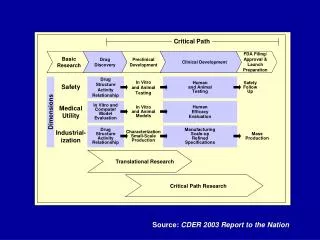
Drug Development Path • Discovery • Candidate selection • Pre-Clinical Studies • Clinical Studies • Commercialization • Post-Approval Manufacturing Optimization • New Indications
Empirical vs. Guided Development Drug Development must be a learning process in order to make intelligent decisions regarding: • Candidate selection • Dosage form and formulation • Clinical indication • Clinical endpoints • Adverse event monitoring • Manufacturing methods
Empirical vs. Guided Development Goal: To establish a knowledge base and the tools necessary to predict the probable success of given products and manufacturing methods and to foster the development of products with a high likelihood of success.
Office of Pharmaceutical Science • Informatics and Computational Safety Analysis Staff • Office of New Drug Chemistry • Office of Generic Drugs • Office of Testing and Research • Office of Biotechnology Products
OPS Critical Path Research • Candidate selection • Dosage form development and evaluation • Toxicity predictions • Bioavailability and bioequivalence prediction • Metabolism prediction • Immunogenicity • Biomarker validity • Mechanism of action • Pharmacogenomics • Manufacturing methodologies
Critical Path Research Strategies Coordinate cooperative research activities: • Predictive modeling based on data from: • Regulatory submissions • FDA laboratory research • Laboratory research from outside collaborators • Published literature
Critical Path Research Strategies Coordinate cooperative research activities: • Laboratory research • OTR • Div. of Applied Pharmacology Research • Div. of Product Quality Research • Div. of Pharmaceutical Analysis • OBP • Div. of Monoclonal Antibodies • Div. of Therapeutic Products • Other FDA Centers • Outside collaborations (Academia, Industry, other Gov’t.)
Utilization of Information • Disseminate to manufacturers via: • Public forums • Guidance documents • Regulatory meetings (pre-IND, pre-NDA, pre-BLA) • Disseminate to reviewers: • Training programs • Mentoring • To enhance the application review process
Questions • Are we focusing on the appropriate Critical Path topics? • Are there others that we should be addressing through our research programs? • How should we identify Critical Path issues in the future and how should we prioritize them?