Structures and Types of Solids
470 likes | 592 Vues
This overview explores the two primary types of solids: crystalline and amorphous. Crystalline solids feature a regular arrangement of particles and can be classified based on their unit cell types, such as simple cubic and face-centered cubic. In contrast, amorphous solids have a disordered structure, exemplified by glass. The determination of solid structures often involves X-ray diffraction, guided by the Bragg equation. Furthermore, the discussion extends to bonding models in metals and the properties of alloys, highlighting their significance in materials science.


Structures and Types of Solids
E N D
Presentation Transcript
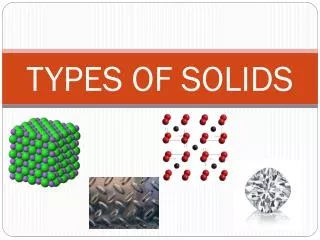
Two types of solids • 1. Crystalline solids • highly regular arrangement of their particles • crystals- at microscopic level
How are they crystals? • Lattice - 3-D system of points indicating position of ions, atoms or molecules that make up the substance
Unit cell • Smallest repeating pattern of the lattice- extend in all directions for the structure
3 types of unit cells • A. Simple cubic • polonium metal • B. Body centered cubic • Uranium metal • C. Face centered cubic • Gold metal
Two types of solids • 2. Amorphous solids- considerable disorder in their structure • EX- glass- liquid that is “frozen in place”
Crystalline solids?? • How do we determine the structure of the solid? • X-ray diffraction!!
Bragg equation • 1915 Noble prize in physics • n = 2dsin • where n= integer = wavelength of x-rays d= distance b/w atoms = angle of incidence
Types of crystalline solids • Easy to classify based on what particle is at lattice point
Types of crystalline solids • Explains why solids have different properties • melting point • conductivity • ductility
Three types • 1. Ionic solids- have ions at the points of the lattice • NaCl
Three types • 2. Molecular solid- have discrete covalently bonded molecules at lattice points • ice
Three types • 3. Atomic solids- substances that have atoms at the lattice points • C, B, Si and all metals
Three types of atomic solids • A. metallic solids- delocalized nondirectional covalent bonding
Three types of atomic solids • B. network solids- atoms bond with strong directional covalent bonds that lead to giant molecules (networks)
Three types of atomic solids • C. Group 8 solids- noble gas elements are attracted by London dispersion forces
Structure and Bonding in Metals • Metals- high thermal and electric conductivity, malleability, ductility- due to nondirectional covalent bonding
Closest packing • Spherical atoms packed together and bonded in all directions • spheres packed in layers-each surrounded by 6 others
Three arrangements • Hexagonal closest packed structure (hcp)- aba arrangement • has hexagonal unit cell
hcp structure • Every other layer has the same vertical position • EX: Mg, Zn
Three arrangements • Cubic closest packed structure (ccp)- abc arrangement • face-centered cubic cell
ccp structure • Every 4th level occupies the same vertical position • EX: Al, Fe, Cu, Co, Ni
Three arrangements • Body centered cubic unit cell (bcc)- spheres touch along the body diagonal of the cube
bcc unit cell • Most spread apart arrangement • EX: alkali metals
Counting atoms... • Need to know number of atoms in a unit cell
Face-centered • 8 cubes share one cell • 1/8 x 8 corners + • 1/2 x 6 faces = • net 4 whole spheres
Density of ccp solid • Ag crystallizes in a ccp structure. The radius of a silver atom is 144pm. Calculate the density of solid silver.
Bonding models for metals • Model must account for physical properties: • A. shape can be changed fairly easily- malleable and ductile
Bonding models for metals • B. durable • C. high melting points
Bonding models for metals • Indicates the bonding is STRONG and NONDIRECTIONAL • or difficult to separate metals atoms, but easy to move them
The model is... • Electron “sea”model • metal cations in sea of e- (mobile e- for conductivity and cations can be moved around when hammered
Last topic-metal alloys! • Metals introduced into the crystal structure of other metals
Alloy • A substance that contains a mixture of elements and has metallic properties
Two types of alloys • Substitutional alloy- some of the host metal atoms are replaced by other metal atoms of similar size
Substitutional alloys • EX: Brass (1/3 of copper atoms replaced with zinc) • Pewter (85%Sn, 7%Cu, 6%Bi, 2%At)
Two types of alloys • Interstitial alloy- formed when some of the holes in a close packed metal structure are occupied by smaller atoms
Interstitial alloy • EX: Steel (carbon atoms into iron) • Strengthens iron by adding strong directional bonds