Bayesian Inference and Its Applications in Imaging Neuroscience
This course explores Bayesian inference methodologies within the context of imaging neuroscience, focusing on critical concepts such as Gaussians, Posterior Probability Maps (PPMs), and Hemodynamic Models (HDMs). Participants will learn to compare models using Dynamic Causal Models (DCMs) and understand parameter estimation through Bayesian methods versus least squares. The course also discusses the computational challenges of applying shrinkage priors and the utility of Bayesian approaches in fMRI studies, especially in examining visual attention and motion processing.

Bayesian Inference and Its Applications in Imaging Neuroscience
E N D
Presentation Transcript
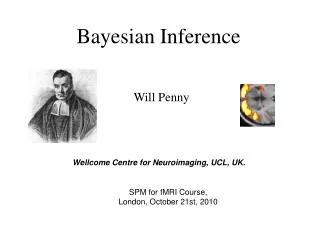
Bayesian Inference Will Penny Wellcome Department of Imaging Neuroscience, University College London, UK SPM Course, London, May 2004
Bayesian Inference • Gaussians • Posterior Probability Maps (PPMs) • Hemodynamic Models (HDMs) • Comparing models (DCMs)
One parameter Likelihood and Prior Posterior Likelihood Prior Posterior Relative Precision Weighting
Posterior Probability Maps - PPMs Bayesian parameter estimation Least squares parameter estimation Shrinkage priors No Priors
Prior Prior: mi 1/a=1
Data Likelihood: yi i=1..V=20 voxels n=1..N=10 scans
Least Squares Estimates Error=7.10
Bayesian Estimates E-Step: M-Step: Iteration 1 Error=7.10
Bayesian Estimates E-Step: M-Step: Iteration 2 Error=2.95
Bayesian Estimates E-Step: M-Step: Iteration 3 Error=2.35
SPMs and PPMs PPMs: Show activations of a given size SPMs: show voxels with non-zero activations
Hemodynamic Models - HDMs Photic Motion Attention fMRI study of attention to visual motion
PPMs Advantages Disadvantages Use of shrinkage priors over voxels is computationally demanding Utility of Bayesian approach is yet to be established One can infer a cause DID NOT elicit a response SPMs conflate effect-size and effect-variability
Photic Photic SPC SPC SPC 0.96 0.85 0.70 0.84 1.36 0.96 V1 V1 V1 0.06 -0.02 V5 0.39 0.57 V5 V5 Motion Motion 0.23 0.58 Attention Attention Photic 0.86 0.75 1.42 0.89 Attention 0.55 -0.02 0.56 Motion Comparing Dynamic Causal Models m=2 m=1 m=3 Bayesian Evidence: Bayes factors: