
Introduction
E N D
Presentation Transcript
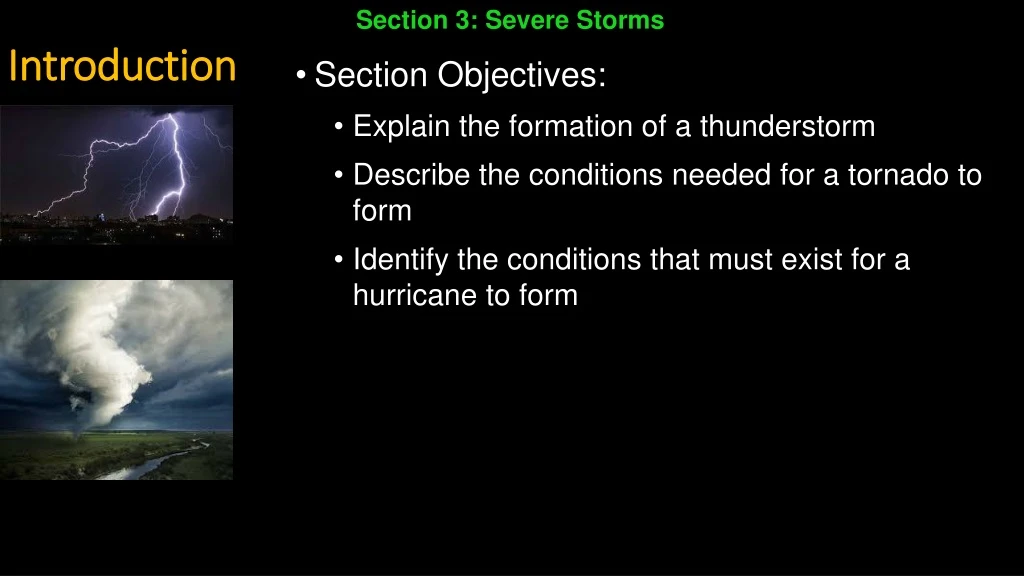
Section 3: Severe Storms Introduction • Section Objectives: • Explain the formation of a thunderstorm • Describe the conditions needed for a tornado to form • Identify the conditions that must exist for a hurricane to form
8. Thunderstorms • A thunderstorm is a storm that generates lightning and thunder • Thunderstorms frequently produce gusty winds, heavy rain, and hail • May be produced by a single cumulonimbus cloud and influence only a small area • Or it may be associated with clusters of cumulonimbus clouds that stretch for km along a cold front • Location of Thunderstorms • At any given time, there are approximately 2000 thunderstorms on Earth • The greatest number occurs in the tropics • Due to warmth, plentiful moisture, and instability
Thunderstorms (cont.) • About 45,000 thunderstorms take place each day • More than 16 million occur annually around the world • The United States experiences about 100,000 thunderstorms each year, • Most frequently in Florida and the eastern Gulf Coast region • The western coast of the US has little thunderstorm activity because warm, moist, unstable maritime tropical air seldom reaches this region
Thunderstorms (cont.) • Development of Thunderstorms • Thunderstorms form when warm, humid air rises in an unstable environment • The development of a thunderstorm generally involves three stages: • Cumulus stage – strong updrafts supply moist air • Each new surge of warm air rises higher than the last • Causes the cloud to grow vertically • A tall cumulonimbus cloud develops which produces rain
Thunderstorms (cont.) • Mature stage – begins within an hour of the first updraft • The number and size of the cloud’s water droplets and ice crystals are too great for the updrafts to support • Heavy precipitation falls from the cloud • Most active stage of a thunderstorm • Strong winds, lightning, heavy precipitation, and sometimes hail are produced • Dissipating stage • Eventually downdrafts dominate throughout the cloud • The cooling effect of the falling precipitation and flowing in of colder air from high above cause the storm to die down
Thunderstorms (cont.) • The life span of a single cumulonimbus unit within a thunderstorm is only about an hour or two. • As the storm moves, however, fresh supplies of warm, humid air generate new cumulonimbus units to replace those that are scattering
9. Tornadoes • A tornado is a violent windstorm that takes the form of a rotating column of air called a vortex • A tornado’s vortex extends downward from a cumulonimbus cloud all the way to the ground • Some tornadoes consist of a single vortex • But within many stronger tornadoes, smaller vortexes rotate within a main funnel • These smaller vortexes have diameters of only about 10 meters and rotate very rapidly
Tornadoes (cont.) • Location and Development of Tornadoes • In the US, about 770 tornadoes are reported each year • Can occur anywhere in the US, but they occur most frequently in Florida and the south-central part of the country • These severe storms can occur at any time during the year • However, the frequency of tornadoes is greatest from April through June • In December and January, tornadoes are far less frequent than in the spring and early summer
Tornadoes (cont.) • Most tornadoes form in association with severe thunderstorms • The development of a mesocyclone is an important process in the formation of many tornadoes • A mesocyclone is a vertical cylinder of rotating air that develops in the updraft of a thunderstorm • The formation of the mesocyclone: • Begins as strong winds high up in the atmosphere cause winds lower in the atmosphere to roll • Strong thunderstorm updrafts cause this rolling air to tilt • Once the air is completely vertical, the mesocyclone is well established • The formation of a mesocyclone does not mean that a tornado will follow
Tornadoes (cont.) • Tornado Intensity • Air pressure within some tornadoes has been estimated to be ~ 10% lower than air pressure immediately outside the storm • Causes air near the ground to rush into a tornado from all directions • As air streams inward, it spirals upward around the core • Eventually, the air merges with the airflow of the cumulonimbus cloud that formed the storm • Because of tremendous amount of pressure change associated with a strong tornado, maximum winds can sometimes approach 480 km/hr
Tornadoes (cont.) • One scale used to estimate tornado intensity is the Fujita tornado intensity scale • Because tornado winds are difficult to measure directly, a rating on this scale is usually determined by assessing the worst damage produced by a storm • Tornado Warning • The Storm Protection Center (SPC) monitors different kinds of severe weather • It’s mission is to provide timely and accurate forecasts and watches for tornadoes and thunderstorms • A tornado warning is issued when a tornado has actually been sighted or is indicated by weather radar
10. Hurricanes • Hurricanes are the most violent storms on Earth • Whirling tropical cyclones that produce sustained winds of at least 119 km/hr are known as hurricanes • Also called typhoons, cyclones, and tropical cyclones • At sea, they can generate 15 m waves capable of destruction hundreds of km away • If a hurricane hits land, strong winds and extensive flooding can cause billions of dollars in damage and great loss of life • Hurricane Katrina, 2005, was the costliest natural disaster in US history, and the deadliest US hurricane since 1928 • Hurricanes are a growing threat because more people are living and working near the coast • > 50% of the US population live within 75 km of the coast
Hurricanes (cont.) • Location of Hurricanes • Most hurricanes form between about 5 and 20⁰ north and south latitude • Hurricanes form in this area because ocean water is warm there • They do not form over cooler ocean water • In a yearly cycle, hurricanes begin most often in the late summer when water temperatures are warm enough to provide the necessary heat and moisture to the air • After beginning, hurricanes can travel thousands of kilometers • It can last a week or more
Hurricanes (cont.) • Development of Hurricanes • A hurricane is fueled by the energy given off when huge quantities of water vapor condense • Begins as a tropical disturbance that consists of disorganized clouds and thunderstorms • Low atmospheric pressures and little to no rotation are characteristic of these disturbances • An inward rush of warm, moist surface air moves toward the core of the storm • The air then turns upward and rises in a ring of cumulonimbus clouds
Hurricanes (cont.) • The doughnut shaped wall that surrounds the center of the storm is the eye wall • Here the greatest wind speeds and heaviest rainfall occur • Surrounding the eye wall are curved bands of clouds that trail away from the center of the storm • Near the top of the hurricane, the rising air is carried away from the storm center • This outflow provides room for more inward flow at the surface • At the very center of the storm is the eye of the hurricane • the eye is a zone where precipitation ceases and winds become less strong • The air within the eye gradually descends and heats, making it the warmest part of the storm
Hurricanes (cont.) • Hurricane Intensity • Described using the Saffir-Simpson scale. • The most devastating damage from a hurricane is caused by storm surges • A storm surge is a dome of water about 65 to 80 km wide that sweeps across the coast where a hurricane’s eye moves onto land • A hurricane weakens when it moves over cool ocean waters that cannot supply adequate heat and moisture • Intensity drops when storms move over land, there’s not sufficient moisture in the air • Contact with rough land surface causes winds to subside • When a hurricane reaches a location where the airflow aloft is unfavorable, it will die out