What Makes Classical Education Effective for Long
1 likes | 1 Vues
In a rapidly changing world, families and educators alike are asking a fundamental question: What kind of education truly prepares students not just for the next test, but for a lifetime of thinking, adapting, and contributing? One answer gaining renewed attention is the classical education approachu2014a model rooted in tradition yet incredibly relevant for todayu2019s learners. Unlike many modern educational trends that focus on short-term performance metrics, classical education prioritizes depth of understanding, critical thinking, and intellectual adaptability, qualities essential for long-term l


What Makes Classical Education Effective for Long
E N D
Presentation Transcript
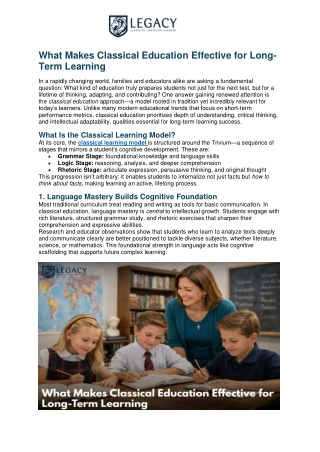
What Makes Classical Education Effective for Long- Term Learning In a rapidly changing world, families and educators alike are asking a fundamental question: What kind of education truly prepares students not just for the next test, but for a lifetime of thinking, adapting, and contributing? One answer gaining renewed attention is the classical education approach—a model rooted in tradition yet incredibly relevant for today’s learners. Unlike many modern educational trends that focus on short-term performance metrics, classical education prioritizes depth of understanding, critical thinking, and intellectual adaptability, qualities essential for long-term learning success. What Is the Classical Learning Model? At its core, the classical learning model is structured around the Trivium—a sequence of stages that mirrors a student’s cognitive development. These are: Grammar Stage: foundational knowledge and language skills Logic Stage: reasoning, analysis, and deeper comprehension Rhetoric Stage: articulate expression, persuasive thinking, and original thought This progression isn’t arbitrary; it enables students to internalize not just facts but how to think about facts, making learning an active, lifelong process. 1. Language Mastery Builds Cognitive Foundation Most traditional curriculum treat reading and writing as tools for basic communication. In classical education, language mastery is central to intellectual growth. Students engage with rich literature, structured grammar study, and rhetoric exercises that sharpen their comprehension and expressive abilities. Research and educator observations show that students who learn to analyze texts deeply and communicate clearly are better positioned to tackle diverse subjects, whether literature, science, or mathematics. This foundational strength in language acts like cognitive scaffolding that supports future complex learning.
2. Critical Thinking Through Logic and Debate A defining feature of classical programs is formal logic instruction and Socratic dialogue. Here, students don’t just receive information, they interrogate it. They learn to identify flawed reasoning, construct coherent arguments, and solve problems systematically. This cultivation of logical thinking yields learners who are capable of: distinguishing fact from opinion analyzing information with clarity evaluating complex problems independently These skills are critical in an age where learners must shift through vast amounts of information and make thoughtful decisions, far beyond rote memorization. 3. Deep Historical and Cultural Context Unlike curriculum models fixated on topical learning, classical education places heavy emphasis on the historical continuum of ideas. Students study history as an interconnected narrative, not isolated dates, fostering a deeper grasp of human behavior, societal change, and cultural development. Engaging with primary sources and the great works of thinkers across eras expands students’ perspective and encourages them to ask meaningful questions like“Why did this happen?” rather than simply “What happened?” Such historical engagement builds reflective, context-aware thinkers, an essential trait for lifelong learners. 4. Character Formation as a Learning Priority One often overlooked aspect of long-term learning is character. Classical education integrates moral and ethical reflection into daily academic life. Rather than treating character as an add-on, it’s woven into how students explore literature, conduct research, and interact with one another. Students are encouraged to practice virtues like perseverance, integrity, and respect, traits that directly support sustained intellectual growth and lifelong learning habits. When learners value truth and effort, they are far more likely to continue growing long after formal schooling ends. 5. The Arts and Sciences for a Balanced Intellect A robust classical program doesn’t neglect creativity or empirical reasoning. The arts, music, poetry, visual art, enhance imagination, cultural appreciation, and expressive skills, while the sciences promote disciplined inquiry and empirical literacy. This interdisciplinary integration ensures students become well-rounded thinkers who can approach problems from multiple angles and adapt knowledge to new contexts, a hallmark of long-term learning success. Real-World Effectiveness: Beyond Graduation Classical education doesn’t just equip students for college or careers; it equips them for life. Students trained in this model learn to: articulate complex ideas clearly think critically under pressure approach unfamiliar subjects with confidence engage in reasoned discussion with diverse viewpoints These competencies rarely fade with time. Graduates typically retain their ability to learn independently, engage with new ideas, and contribute meaningfully to society long after formal schooling concludes.
Choosing the Right Environment for Classical Education For families seeking an environment aligned with these enduring educational principles, even community-focused schools like a classical academy near Haslet TX offer structured programs that emphasize deep learning and intellectual rigor. These institutions apply classical principles while also adapting to contemporary educational needs, giving students both foundational excellence and future readiness. Similarly, parents who wish to apply to classical Christian academy programs find that these schools often pair traditional academic rigor with spiritual and moral formation, creating an environment where intellectual curiosity and character development go hand-in-hand. Conclusion What makes classical education effective for long-term learning isn’t a single strategy, it’s the harmonious integration of foundational language mastery, logical reasoning, historical perspective, character formation, and a balanced curriculum that includes the arts and sciences. Unlike short-term achievement models, classical education teaches learners how to learn, shaping minds that remain curious, disciplined, and adaptable throughout life. As educators and parents look to the future, this time-tested educational framework continues to emerge as one of the most effective pathways to lifelong intellectual growth and meaningful contribution.