Remote Controlled Robotic Arm with 6 Degrees of Freedom
This presentation outlines a project on a remote-controlled robotic arm featuring six degrees of freedom. The system consists of two main components: a control sleeve that tracks human arm movement and a robotic arm that mimics this motion. Key challenges include servo motor management, power regulation, and communication protocols. Each team member contributed to various aspects of the project, from hardware and software development to packaging and testing. The project aims for precise control of the robotic arm and the ability to record and repeat user actions.

Remote Controlled Robotic Arm with 6 Degrees of Freedom
E N D
Presentation Transcript
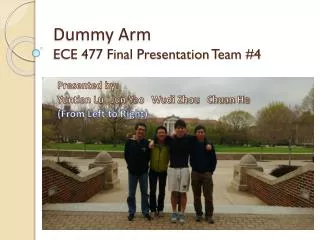
Dummy ArmECE 477 Final Presentation Team #4 Presented by: Yuntian Lu Jun Yao Wudi Zhou Chuan He (From Left to Right)
Outline • Project overview • Block diagram • Design challenges • Individual contributions • Project demonstration • Questions / discussion
Project Overview • An remote controlled robot arm with 6 degree of freedom. It consists of two major component control sleeve and robot arm. Control sleeve is responsible for measuring the motion of the human arm. Robot arm will mimic the same motion. controlled robot arm with 6 degree of freedom. It consists of two major component control sleeve and robot arm. Control sleeve is responsible for measuring the motion of the human arm. Robot arm will mimic the same An remote controlled robot arm with 6 degree of freedom. It consists of two major component control sleeve and robot arm. Control sleeve is responsible for measuring the motion of the human arm. Robot arm will mimic the s
Design Challenges • Servo Motors • Power Regulation • Internal Clock • I2C Sensors • Angle Calculations • XBee Communication • Package Design
Chuan He • Team Leader • Peripheral driver for I2C, Flash, Timer, GPIO, Clock • Schematic/PCB design for Control Sleeve • Software development for Control Sleeve • Internal communication protocol development • Integration and debugging • Helped with final package
Yuntian Lu • Schematic/PCB design for robotic arm • Power supply design • Peripheral driver for ADC and PWM • Software development for robotic arm and position tracking algorithm • Internal communication protocol development • Integration and debugging • Helped with final package
Wudi Zhou • Hardware and packaging design • Soldered two of our PCBs and made peripheral circuits • Design and packaging the sensors for control sleeve • Finish the final packaging • Testing and debugging • Yuntian and I tested the whole system in different stages of the design • Debug the algorithms to get correct PWM signals for our motors
Jun Yao • Hardware selection – robotic arm • Schematic – PWM module • Software development – XBee, LCD, internal clock setup • Packaging – prototype box panel layout
Project-Specific Success Criteria • An ability to precisely control the position of the robotic arm which has six degrees of freedom • An ability to sense and capture the motion of human (user’s) arm including grasp, rotations of wrist, elbow and shoulder. • An ability to record and store the actions at least 60 seconds performed by robot arms for repeating the same actions in the future • An ability to display degree of each motor and pressure on the gripper onto LCD • An ability to encode and decode an control signals and send the signal through wireless module.