Download
1 / 15
150 likes | 278 Vues
Understand the concept of Return on Investment (ROI) and its application in health programs for improved efficiency. Learn simple ROI calculations, benefits, and how to enhance business cases. Utilize ROI as a decision-making tool for program success.

E N D
Using Return on Investment (ROI) to Guide Programmatic Health Sara Sack, Director Assistive Technology for Kansans Shaping a National Collaborative for AT Reutilization Conference, Sept. 16, 2009
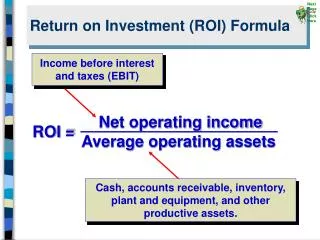
Cost Benefit, Simple ROI, ROI/Business Case: What Are We Talking About? • Similar but slightly different terms • Cost Benefits – a general list. • ROI – performance measure to compare efficiency of different investments. • ROI/Business Case – stated definitions and assumptions and yields some insights on how to improve business in the future.
Simple ROI Calculation • ROI = (Gains from investment – Cost of investments) divided by Cost of investment • Which is a better investment? • $1,000 that earns $50 • $100 that earns $20
Simple ROI Calculation • $1,000 that earns $50 • ($1050 - $1,000)/ $1000 = .05 or 5% ROI • $100 that earns $20 • ($120 - $100)/$100 = .20 or 20% ROI
Collection Drive Complex ROI • Assumptions/Benefits • Accept only lightly used, high cost or bariatric DME. • Increased DME provider and network partner involvement. • Increased public’s awareness of program resulting in increased donations and requests.
ROI is a Useful Tool for: • ROI is a useful tool for making program decisions. • Consider conducting ROI for: • pickup and delivery, • shipping, • collection drives, • methods of cleaning and sanitization (volunteers, paid staff, contractor, purchase of sanitizing equipment)
Questions? • Sara Sack, 620-421-8367 or ssack@ku.edu