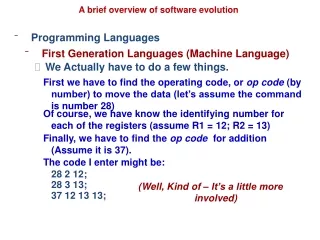
Programming Languages
Programming Languages. Outline. What makes programming languages an interesting subject? The amazing variety The odd controversies The intriguing evolution The connection to programming practice. HOW MANY PROGRAMMING LANGUAGES ARE THERE?. The Amazing Variety.

Programming Languages
E N D
Presentation Transcript
Programming Languages Modern Programming Languages
Outline • What makes programming languages an interesting subject? • The amazing variety • The odd controversies • The intriguing evolution • The connection to programming practice Modern Programming Languages
HOW MANY PROGRAMMING LANGUAGES ARE THERE? Modern Programming Languages
The Amazing Variety • There are very many, very different languages • Thousands! • See http://en.wikipedia.org/wiki/List_of_programming_languages Modern Programming Languages
Programming Paradigms • Often grouped into four major families: • Imperative • Functional • Logic • [Object-oriented (evolved from Imperative)] Modern Programming Languages
Imperative Languages • Example: a factorial function in C • Hallmarks of imperative languages: • Assignment • Iteration • Order of execution is critical int fact(int n) { int sofar = 1; while (n>0) sofar *= n--; return sofar;} Modern Programming Languages
Functional Languages • Example: a factorial function in ML • Hallmarks of functional languages: • Single-valued variables (immutable) • Heavy use of recursion (vs. iteration) fun fact x = if x <= 0 then 1 else x * fact(x-1); Modern Programming Languages
Logic Languages • Example: a factorial function in Prolog • Hallmark of logic languages • Program expressed as rules in formal logic fact(X,1) :- X =:= 1.fact(X,Fact) :- X > 1, NewX is X - 1, fact(NewX,NF), Fact is X * NF. Modern Programming Languages
Object-Oriented Languages • Hallmarks of object-oriented languages: • Usually imperative, plus… • Constructs to help programmers use “objects”—little bundles of data that know how to do things Modern Programming Languages
Strengths and Weaknesses • The different language groups show their “Stuff” on different kinds of problems • For now, one comment: don’t jump to conclusions based on factorial! • Functional languages do well on such functions • Imperative languages, a bit less well • Logic languages, considerably less well • Object-oriented languages need larger examples Modern Programming Languages
About Those Families • There are many other language family terms (not exhaustive and sometimes overlapping) • Applicative, concurrent, constraint, declarative, definitional, procedural, scripting, • Some languages straddle families • Others are so unique that assigning them to a family is pointless • FORTH, APL Modern Programming Languages
Example: Forth Factorial • A stack-oriented language • Postscript is similar • Could be called imperative, but has little in common with most imperative languages : FACTORIAL 1 SWAP BEGIN ?DUP WHILE TUCK * SWAP 1- REPEAT ; Modern Programming Languages
Example: APL Factorial • An APL expression that computes X’s factorial • Expands X it into a vector of the integers 1..X, then multiplies them all together • (You would not really do it that way in APL, since there is a predefined factorial operator: !X) • Could be called functional, but has little in common with most functional languages X Modern Programming Languages
The Odd Controversies • Programming languages are the subject of many heated debates: • Partisan arguments • Language standards • Fundamental definitions Modern Programming Languages
Language Partisans • There is a lot of argument about the relative merits of different languages • Every language has partisans, who praise it in extreme terms and defend it against all detractors • To experience some of this, explore newsgroups: comp.lang.* • (Plenty of rational discussion there too!) Modern Programming Languages
Language Standards • The documents that define language standards are often drafted by international committees • Can be a slow, complicated and rancorous process • Fortran 82 8X 88 90 standard released in 1991 • C++: 1998 / 2003 / 2011 • ECMAScript, CLI Modern Programming Languages
Basic Definitions • Some terms refer to fuzzy concepts: all those language family names, for example • No problem; just remember they are fuzzy • Bad: Is X really an object-oriented language? • Good: What aspects of X support an object-oriented style of programming? • Some crisp concepts have conflicting terminology: one person’s argument is another person’s actual parameter Modern Programming Languages
The Intriguing Evolution • Programming languages are evolving rapidly • New languages are being invented • Old ones are developing new dialects Modern Programming Languages
Widely Used: Java • Quick rise to popularity since 1995 release • Java uses many ideas from C++, plus some from Mesa, Modula, and other languages • C++ uses most of C and extends it with ideas from Simula 67, Ada, Clu, ML and Algol 68 • C was derived from B, which was derived from BCPL, which was derived from CPL, which was derived from Algol 60 Modern Programming Languages
Not Widely Used: Algol • One of the earliest languages: Algol 58, Algol 60, Algol 68 • Never widely used • but very influential! • Introduced many ideas that were used in later languages, including: • Block structure and scope • Recursive functions • Parameter passing by value Modern Programming Languages
tiobe.com • www.tiobe.com • Programming popularity index • Updated monthly Modern Programming Languages
Language Influences Programming Practice • Languages often strongly favor a particular style of programming • Object-oriented languages: a style making heavy use of dynamic objects • Functional languages: a style using many small side-effect-free functions • Logic languages: a style using searches in a logically-defined problem space Modern Programming Languages
Fighting the Language • Languages favor a particular style, but do not force the programmer to follow it • It is always possible to write in a style not favored by the language • It is not usually a good idea… Modern Programming Languages
Imperative ML ML makes it hard to use assignment and side-effects. But it is still possible: fun fact n = let val i = ref 1; val xn = ref n in while !xn>1 do ( i := !i * !xn; xn := !xn - 1 ); !i end; Modern Programming Languages
Non-object-oriented Java Java, more than C++, tries to encourage you to adopt an object-oriented mode. But you can still put your whole program into static methods of a single class: class Fubar { public static void main (String[] args) { // whole program here! } } Modern Programming Languages
Other Connections: Computer Architecture • Language evolution drives and is driven by hardware evolution: • Call-stack support – languages with recursion • Parallel architectures – parallel languages • Internet – Java, PHP Modern Programming Languages
Turing Equivalence • Languages have different strengths, but fundamentally they all have the same power • {problems solvable in Java}= {problems solvable in Fortran}= … • And all have the same power as various mathematical models of computation • = {problems solvable by Turing machine}= {problems solvable by lambda calculus}= … • Church-Turing thesis: this is what “computability” means Modern Programming Languages