Download
1 / 23
230 likes | 352 Vues
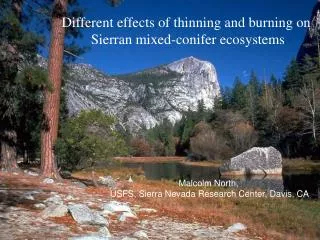
Mixed conifer forests, found at elevations of 8,000-10,000 ft and receiving 25-30 inches of annual precipitation, are among the most complex and heterogeneous forest types. They are classified into two general types: Warm-dry and Cool-wet mixed conifer forests. Warm-dry forests feature species like Ponderosa pine and Douglas-fir, while Cool-wet forests are characterized by white fir and blue spruce. Both types exhibit unique stand structures, disturbance regimes, and responses to fire events, influenced by factors such as fire suppression and land use changes from Euro-American settlement.

E N D
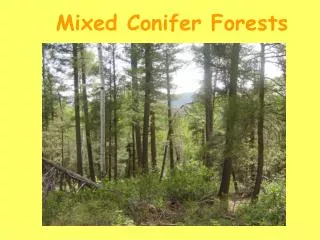
Mixed Conifer Forests * ~8,000-10,000 ft elevation * 25-30 inches of precipitation/annually * very complex and heterogeneous in structure, composition, and disturbance history.
Mixed Conifer Forests -most variable and complex of any forest type -received relatively little research attention Two general types: 1) Warm-dry Mixed Conifer 2) Cool-wet Mixed Conifer
Warm-dry Mixed Conifer -shares some of the major species of ponderosa pine forests -resembles ponderosa pine forests in terms of stand structure and disturbance regimes
Cool-wet Mixed Conifer -shares some of the major species of spruce-fir forests -similar stand structure and disturbance regime as spruce-fir
Warm-dry Mixed Conifer -lower elevations, southerly aspects -ponderosa pine, Douglas-fir, aspen, white fir, Gambel oak, other shrubs -recurrent, non-lethal fires (20-50 yr intervals); rare lethal fires (>100 yr intervals) -episodic establishment of pine and Douglas-fir, perhaps mainly after fire; adult trees survive non-lethal fire
Cool-wet Mixed Conifer -higher elevations, northerly aspects -white fir, Douglas-fir, aspen, blue spruce, snowberry, other shrubs -lethal fires at long intervals (>100 yr); occasional small non-lethal fires; landscape patch mosaic -episodic establishment of Douglas-fir, perhaps mainly after fire; aspen may dominate stand after lethal fire
EURO-AMERICAN SETTLEMENT FIRE SUPPRESSION GRAZING LOGGING