
SlideServe
Menu
Préférences
© SlideServe · v2026

Understanding Radians and Degrees: Conversions and Applications

len-schroeder avatar
7 diapositives · 462 Views · Nov 13, 2014

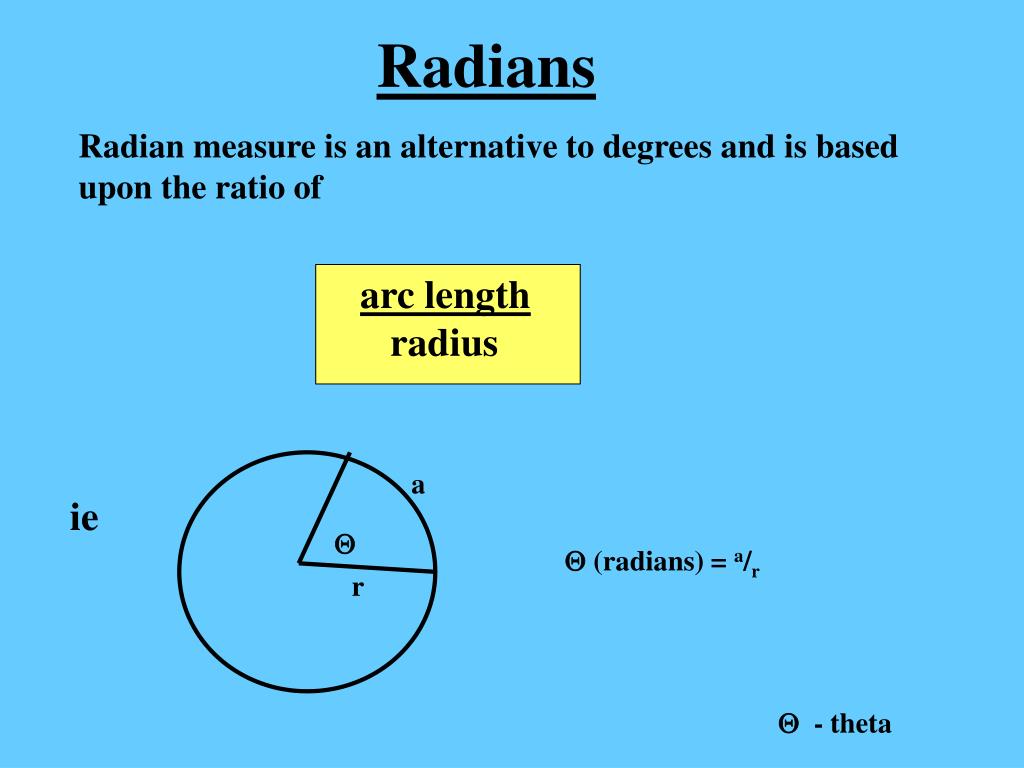
Radians offer an alternative to degrees for measuring angles, based on arc length ratios. For instance, when the arc length equals the radius, the angle in radians is 1 (θ = a/r). In a semicircle, the connection between degrees and radians reveals π radians equals 180°, establishing relationships for various angles. This article discusses converting degrees to radians and vice versa using key examples and presents the concept of angular velocity in the context of musical vinyl records, illustrating practical applications of radians in everyday scenarios.
Understanding Radians and Degrees: Conversions and Applications - slide 1
01 / 7Understanding Radians and Degrees: Conversions and Applications
1 / 17

Télécharger la présentation

Understanding Radians and Degrees: Conversions and Applications
Une image / un lien ci-dessous est fourni (tel quel) pour télécharger la présentation

Politique de téléchargement : le contenu du site vous est fourni TEL QUEL pour votre information et votre usage personnel ; il ne peut être vendu, concédé sous licence ni partagé sur d’autres sites sans l’accord de son auteur.Le contenu vous est fourni TEL QUEL, pour votre information et votre usage personnel uniquement. Téléchargez la présentation en cliquant sur ce lien. Lors du téléchargement, si vous ne parvenez pas à télécharger une présentation, l’éditeur a peut-être supprimé le fichier de son serveur.Pendant le téléchargement, si vous ne parvenez pas à obtenir une présentation, le fichier a peut-être été supprimé par l’éditeur.

F I N

Plus de contenu associé

Transcription de la présentation
  1. Radians Radian measure is an alternative to degrees and is based upon the ratio of arc length radius a ie   (radians) = a/r r  - theta

  2. If the arc length = the radius ie r   (radians) = r/r = 1 r If we now take a semi-circle a Here a = ½ of circumference ie = ½ of d  = r r So  (radians) = r /r = 

  3. Since we have a semi-circle the the angle must be 180. We now get a simple connection between degrees and radians.  (radians) = 180 This now gives us 2 = 360 /2 = 90 3/2 = 270 /3 = 60 2/3 = 120 /4 = 45 3/4 = 135 /6 = 30 5/6 = 150 etc NB: radians are usually expressed as fractional multiples of.

  4. Converting 180 X  degrees radians   X 180 The fraction button on your calculator ab/c can be very useful here

  5. Ex1 72 = 72/180 X  = 2 /5 Ex2 330 = 330/180 X  = 11 /6 Ex32 /9 = 2 /9 X 180 = 2/9 X 180 = 40 Ex423 /18 = 23 /18 X 180 = 23/18 X 180 = 230

  6. Example 5 Angular Velocity In the days before CDs the most popular format for music was “vinyls”. Singles played at 45rpm while albums played at 331/3 rpm. rpm =revolutions per minute ! Going back about 70 years an earlier version of vinyls played at 78rpm. Convert these record speeds into “radians per second”.

  7. NB: 1 revolution = 360 = 2 radians 1 min = 60 secs So 45rpm = 45 X 2 or 90 radians per min = 90/60 or 3/2 radians per sec So 331/3rpm = 331/3 X 2 or 662/3  radians per min = 662/3 /60 or 10/9 radians per sec So 78rpm = 78 X 2 or 156 radians per min = 156/60 or 13/5 radians per sec