
Solving for x and y in Equilateral and Isosceles Triangles
E N D
Presentation Transcript
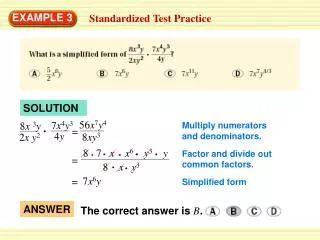
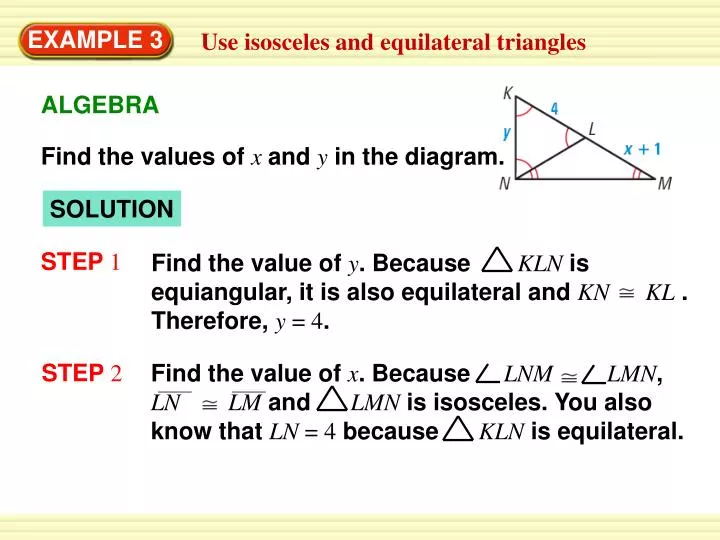
ALGEBRA Find the values of x and yin the diagram. STEP 1 Find the value of y. Because KLNis equiangular, it is also equilateral and KN KL. Therefore, y = 4. STEP 2 Find the value of x. Because LNM LMN, LN LMand LMNis isosceles. You also know that LN = 4 because KLNis equilateral. EXAMPLE 3 Use isosceles and equilateral triangles SOLUTION
EXAMPLE 3 Use isosceles and equilateral triangles LN = LM Definition of congruent segments 4 = x + 1 Substitute 4 for LNand x + 1 for LM. 3 = x Subtract 1 from each side.
In the lifeguard tower, PS QRand QPS PQR. What congruence postulate can you use to prove that QPS PQR? Explain why PQTis isosceles. Show thatPTS QTR. EXAMPLE 4 Solve a multi-step problem Lifeguard Tower
Draw and label QPSand PQRso that they do not overlap. You can see that PQ QP, PS QR, and QPS PQR. So, by the SAS Congruence Postulate, QPS PQR. From part (a), you know that 1 2 because corresp. parts of are . By the Converse of the Base Angles Theorem, PT QT, and PQTis isosceles. EXAMPLE 4 Solve a multi-step problem SOLUTION
EXAMPLE 4 Solve a multi-step problem You know that PS QR, and 3 4 because corresp. parts of are . Also, PTS QTRby the Vertical Angles Congruence Theorem. So, PTS QTRby the AAS Congruence Theorem.
Find the values of x and yin the diagram. We name the triangle as ABC and CBD CBD is equilateral triangle which guarantees the angle measure 60° therefore x° = 60° for Examples 3 and 4 GUIDED PRACTICE SOLUTION y° = 180° – x° y° = 180° – 60° y° = 120° x° = 180° – y° = 60°
Use parts (b) and (c) in Example 4 and the SSS Congruence Postulate to give a different proof that PTS QTR QPSPQR. Can be shown by segment addition postulate i.e QT + TS = QSand PT + TR = PR a. for Examples 3 and 4 GUIDED PRACTICE SOLUTION
b. c. QS PR reflexive property and PQ PQ given PS QR ANSWER ThereforeQPS PQR.BySSS congruence Postulate TS TR for Examples 3 and 4 GUIDED PRACTICE SincePT QTfrom part and from part then,