Download
1 / 18
180 likes | 289 Vues
Discover the rich history of the Byzantine Empire, a bridge between East and West, known for its strategic location in Constantinople at the Bosporus Strait. We explore its culture, economy, and artworks such as mosaics, while examining its religious and political distinctions compared to the Latin West. The remarkable reign of Justinian and Theodora shaped its legal systems, art, and architecture, including the iconic Hagia Sophia. The Empire's decline, influenced by military defeats, external threats, and the schism of 1054, marks a significant turning point in history.

E N D
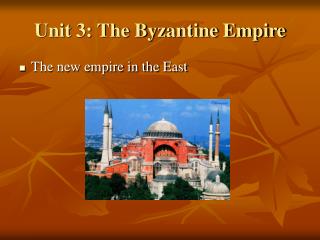
Unit 3: The Byzantine Empire • The new empire in the East
Geography • Constantinople • Location • The Bosporus strait • Trade • Defense • Walls • Moat • Peninsula
The West Language Latin Legal system Religion Education Economy Lifestyle Art/Architecture The East Language Greek Legal system Religion Education Economy Lifestyle Art/Architecture Latin West vs. the Byzantine East
Economy and Politics • Byzantine Prosperity • Trade (silk) • Art (mosaics) • Weapons (Greek Fire) • The Relationship between church and state • East (Bishop chosen by Emperor) • West (Pope chooses HRE)
The Split between East and West • Christianity • Language • Ceremonies / Holy days • Filioque statement • Iconoclasm • Married clergy • “One God, one Emperor, one religion • The Schism of 1054 • Eastern Orthodox Church
Justinian and Theodora (527-565) • Justinian's Code • Theodora (wife) • The Hagia Sophia • Conquest of the West • The Stirrup
The Byzantine Empire Besieged • By 631 had lost back all of the land in the West • Why? • The Emergence of Islam • 717 Muslim Navy repelled by Greek Fire • Slavs in the Balkans in the 11th Century
The Decline of the Byzantine Empire • Military never great (diplomacy now less effective) • 1071 The Battle of Manzikert (Seljuk Turks) • Wiped out the Byzantine army • 1204: 4th Crusade took Constantinople • 1453: Ottoman Turks • Memhed II
The Steppe • Dry grassland from Manchuria to Hungry • Western Steppe • Central Asia to Europe • Eastern Steppe • Present-day Mongolia • Little rain • Dry wind that supports rugged type of grass
Nomadic Way of Life • Pastoralist • Constantly on the move looking for new areas to graze • Nomads don’t aimlessly wander, they followed a seasonal pattern. • Battles often erupted over the land • Clans • Family groups
Temujin • Born into legend • Father was killed when he was 9 • Mother raised the family in poverty. • Revenge (Tatars) • 1200 A.D. • Temujin brought the clans together as one group • “Universal Leader” • Genghis Khan (1206) • Led the Mongols in conquering much of Asia
Genghis the Conqueror • Brilliant organizer • Gifted strategist • Used tricks to decisive his enemies • Fake retreat • Adopted new weapons and strategies • Horse • Bow • Used cruelty as a weapon • Psychological warfare • One of the first people to use terrorism
The Mongol Empire • After the death of Genghis Kahn his territory was divided by his heirs • Khanates • Kublai Kahn began the Yuan Dynasty of China • Defeated in 1368 by the Ming Dynasty