Download
1 / 6
100 likes | 259 Vues
This educational resource focuses on the fundamental properties of triangles, demonstrating that the angles in a triangle always sum to 180 degrees. It covers the calculation of angles, showcasing relationships such as the exterior angle being equal to the sum of the opposite interior angles. Additionally, it introduces the characteristics of different types of triangles, including isosceles, equilateral, and right-angled triangles. Through practical examples and exercises, students can enhance their understanding of angle relationships and triangle properties.

E N D
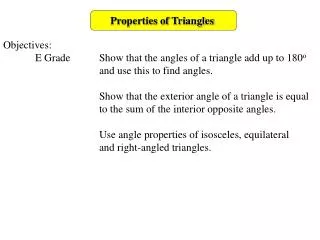
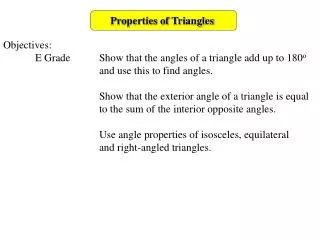
Properties of Triangles Objectives: E Grade Show that the angles of a triangle add up to 180o and use this to find angles. Show that the exterior angle of a triangle is equal to the sum of the interior opposite angles. Use angle properties of isosceles, equilateral and right-angled triangles.
Properties of Triangles Using the symbols describing shapes answer the following questions: b 45o d a c 36o Equilateral triangle all angles are equal Isosceles triangle Two angles are equal Right-angled triangle c = 180 ÷ 3 = 60o a = 36o d = 180 – (45 + 90) = 45o b = 180 – (2 × 36) = 108o
Properties of Triangles Example Made up of 2 isosceles triangles p = 38o q 36o s q = 180 – (2 × 38) = 104o p r 56 + (r + s) = 180o 56o (r + s) = 180 – 56 = 124 Because r = s r = s = 124 ÷ 2 = 62o
Properties of Triangles Now do these: h = i Equilateral triangle h + i = 180 - 90 a = 64o c = d e = f = g = 60o h + i = 90 b = 180 – (2 ×64o ) = 52o c + d = 180 - 72 c = d = 45o c + d = 108 c = d = 54o p = 50o q = 180 – (2 ×50o ) = 80o r = q = 80o vertically opposite angles are equal Therefore: s = t = p = 50o
Properties of Triangles p = q = r = 60o e = f = g = 60o d = 180 – 60 = 120o s = t = 180 - 43= 68.5o 2 e + 18 = a = 60 external angle = sum of opposite internal angles e = 60 – 18 = 42o
Worksheet Properties of Triangles