Download
1 / 20
220 likes | 355 Vues
The Inca Empire, located in South America, thrived from the Andes Mountains to present-day Peru in the mid-1400s under Emperor Pachacuti. Known for its strong central government, the Incas controlled an extensive territory, housing about 12 million people. Their economy, devoid of merchants or markets, was based on a labor tax system called mita, while society was distinctly divided into upper and lower classes. The empire's achievements included advanced masonry, extensive road networks, and unique textile artistry. However, internal civil strife and the conquest by Francisco Pizarro in the 1530s led to its downfall.

E N D
The Incas 16.3 Chapter 16 Section 3
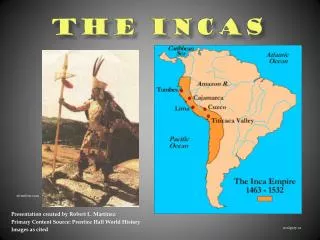
Geography • Located in South America • Began in the Andes Mountains • Capital is located in present-day Peru • Deserts, snowy mountains, fertile valleys, lush forests
Create an Empire • Mid 1400’s- Emperor Pachacuti [pah-chah-KOO-tee] began to expand territory • Early 1500’s-empire was huge • From Ecuador to central Chile • About 12 million people lived in empire
Strong Central Government • Conquered landruledby trusted governmentofficials • Kids sent to capital to learn Inca way • Returned later • Quechua [KE-chuh-wuh] officialIncalanguage • All business spoken in this language • Still spoken today
Economy • Governmentstrictly controlled economy • People worked for government and themselves • Mita [MEE-tah]- labor tax • No merchants or markets • Government distributed goods • Leftovers stored for later
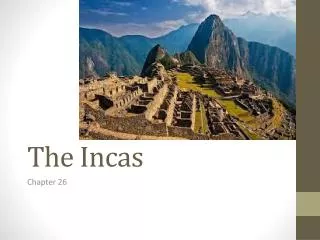
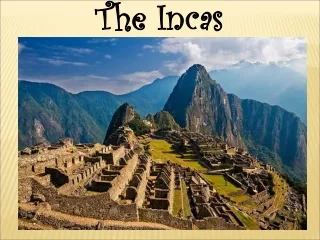
Social Divisions • Upper Class • Emperor, priests, government officials • Didn’t pay labor tax, best clothes, lived in stone houses • Could relax in Machu Picchu
Lower Class • Farmers, artisans, servants • Maize, peanuts, potatoes, and llamas • NO slaves • Lived simply • Law stated couldn’t own more than needed to survive
Religion • Rulers related to sun god; could never die • Sacrifices • Rarely human • Llamas, cloth, or food • Outside capital people worshipped other gods • Certain items had magical powers
Achievements • Grand builders • Masonry [stonework] • Network of roads • 2 major highways • Artisans • Pottery, gold and silver jewerly, textiles • NO WRITTEN LANGUAGE • Quipas [ KEE-pooz] knotted cord system • Official “memorizers”
Pizarro Conquers the Incas • 1520’s- civil war broke out after emperor died • Atahualpa [ah-tah-WAHL-pah] new leader • Francisco Pizarro • 1532 met new ruler, surprise attack • 180 vs. 1,000’s • Captured emperor
Ruler for price • More than 24 tons of gold and silver • Worth millions of $ today • Still killed ruler; feared retribution • 1537- Pizarro defeated Incas • Spain took control of empire for next 300 years