Understanding the Listen Interval in IEEE 802.11: A Review by David Halasz
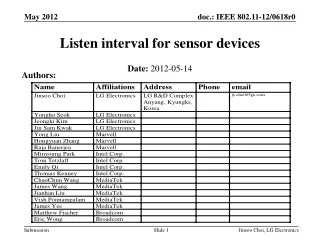
This review by David Halasz from OakTree Wireless examines the Listen Interval as defined in clause 7.3.1.6 of the IEEE 802.11-2007 standard. The Listen Interval specifies how frequently a Station (STA) wakes up to receive beacon frames, expressed in Beacon Interval units. It plays a crucial role in determining how long an Access Point (AP) buffers frames for a STA. The article explores current usage, potential need for longer intervals, and implications for wireless communication efficiency.

Understanding the Listen Interval in IEEE 802.11: A Review by David Halasz
E N D
Presentation Transcript
Listen Interval Review Date: 2010-11-07 Authors: David Halasz, OakTree Wireless
The Listen Interval is defined in clause 7.3.1.6 of IEEE 802.11-2007 • Indicates how often a STA wakes up for beacons • Units are in units of Beacon Interval • Gets sent in Association/Re-association • AP may use the listen interval to determine how long to buffer frames for a STA • Example, • 100 mS Beacon interval x 32767 = 54.6 minutes • Is the Listen Interval used today? • Is a longer period needed? Review of the Listen Interval David Halasz, OakTree Wireless