
330 likes | 559 Vues
This work discusses the development of a coherent subnanosecond single electron source, which offers a controlled method for injecting individual electrons into a quantum conductor. Research by Gwendal Fève and team leverages time-controlled injection strategies and quantum dot technologies to achieve precise electron manipulation. The findings show excellent agreement with theoretical models, paving the way for advancements in quantum electronics and quantum information processing. This breakthrough enhances capabilities in charge dynamics and single charge injection applications.
E N D
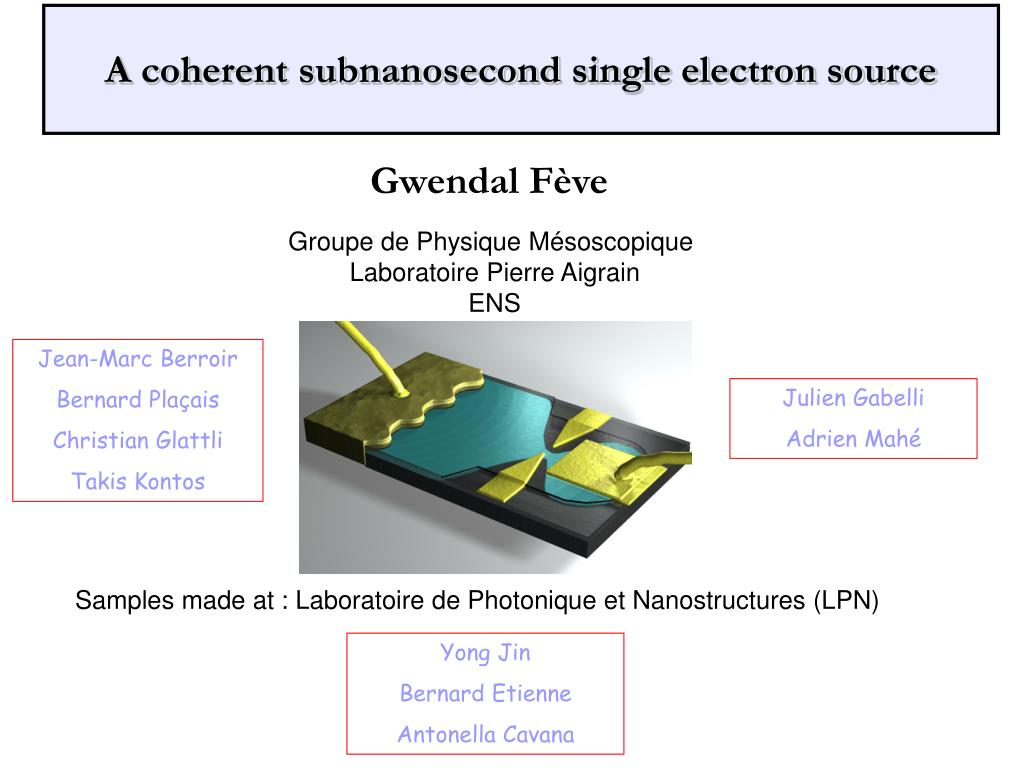
A coherent subnanosecond single electron source Gwendal Fève Groupe de Physique Mésoscopique Laboratoire Pierre Aigrain ENS Jean-Marc Berroir Bernard Plaçais Christian Glattli Takis Kontos Julien Gabelli Adrien Mahé Samples made at : Laboratoire de Photonique et Nanostructures (LPN) Yong Jin Bernard Etienne Antonella Cavana
Motivation Gaz 2D I VG Weizmann Institute, Israel Y. Ji et al Nature 422 415 (2003) Poster P. Roulleau, CEA Saclay
Single electron sources 1,0 1 .8 .6 .4 .2 0 ( ) - 1 T 0,8 D 1 Objective :realisationof a single electron source similar to single photon sources 0,6 ( ) Kumar et al. PRL (1996) - Fano reduction factor T 1 T 2 2 Time controlled injection of a single electron in a quantum conductor 0,4 + 1 T 2 0,2 Electron optics with one or two electrons (entanglement…) 0,0 0. 0.5 1. 1.5 2. 2.5 Conductance 2e² / h DC biased Fermi sea is a noiseless electron source: No temporal control A. Kumar et al. Phys. Rev. Lett. 76 (1996) 2778..
Principle of single charge injection Gaz 2D QPC Boîte e V(t) D V(t)
Principle of single charge injection Gaz 2D QPC Boîte e V(t) V(t)
Principle of single charge injection Gaz 2D QPC Boîte e V(t) • 100 ps for D=2.5°K and D =0.2 injection I V(t)
The quantum RC circuit l < mm
The quantum RC circuit Quantum dot D=t2 No spin degeneracy One dimensional conductor
Linear dynamics of the quantum RC circuit Linear regime,
The quantum RC circuit, T=0K CPQ , dot density of states The resistance is constant, independent of transmission, and equals half the resistance quantum for a single mode conductor ! M. Büttiker et al PRL 70 4114, PLA180,364-369 (1993)
The quantum RC circuit , T=0K • kBT >> DD Sequential regime Quantum dot D=t2 • kBT << DD Coherent regime
Complex conductance Fit by D
Conclusion on linear dynamics linear regime: • dot spectroscopy • charge dynamics • complete determination of experimental parameters J.Gabelli, G.Fève et al Science 313 499 (2006)
Towards single charge injection Injection regime : Mean transferred charge by alternance : The transferred charge is quantized Régime linéaire : Charge moyenne transférée par alternance :
Current detection • In time domain : 16 odd harmonics of the current courant in a 1 GHz bandwidth • Measurement of the first harmonic : Fast averaging acquisition card Acquiris, Temporal resolution 500 ps. Developed by Adrien Mahé Slow excitation f=31.25 MHz « slow » dynamics Faster excitation f=180 MHz and f=515 MHz More accurate determination of the transferred charge And of the escape time in the subnanoseond domain :
Time domain evolution of the current Average on 108 electrons
Response to a non-linear square excitation Simplification : • non-linear : First harmonic :
Response to a non-linear square excitation N(e) D D<<1 , D»1 1/D << e
First harmonic measurement (linear regime) 2eVexc=3/2 D 2eVexc=5/4 D 2eVexc= D 2eVexc=3/4 D 2eVexc=1/2 D 2eVexc=1/4 D
Dot potential dependence f = 182 MHz N(e)
AC current diamonds 2 3 4 0 D 0.02 0.15 0.4 0.8 0.9 Modelling : 2eVexc -912 -907 -902 -897 -892 -887 VG (mV) Im (Iw) (ef) 1
Conclusion • Quantization of the injected charge 1st stage towards the realisation of a single electron source • Injection dyanmics measured in a large temporal range from 0.1 to 10 ns • Excellent agreement with a simple modeling
Prospect • Electron-electron collision : Indistinguishibility of two independent sources
Experimental setup G=X+iY local 3 cm 3 mm dc rf