Christianity: Accelerating change
This document explores the significant changes in European society between the 11th and 15th centuries, focusing on population growth, urbanization, trade routes, and the evolving roles of women. It highlights the dramatic increases in populations in major cities, the establishment of new guilds, and the rise and fall of women's economic contributions. The impact of climate on agriculture and the consolidation of monarchies are also examined, along with the shift in trade networks and product exchanges across regions.

Christianity: Accelerating change
E N D
Presentation Transcript
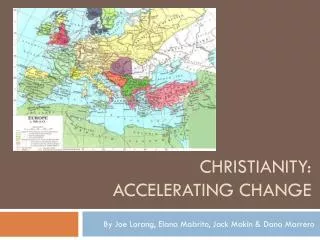
Christianity:Accelerating change By Joe Lorang, Elana Mabrito, Jack Makin & Dana Marrero
Population • Populations increase by a lot • Early 1300’s • London = 40,000 • Paris = 80,000 • Hangzhou (Song Dynasty capital) = 1,000,0000 • Córdoba (Muslim Spain) = 500,000 • End of the 14th Century • Venice = 150,000 • By the end of the 15th Century • Tenochtitlán = 200,000
Populations: Towns • New towns attract new groups of people • Merchants • Bankers • Artisans • Lawyers • Doctors • Scholars • Created guilds • More productive division of labor was introduced to the European Society
Trade: General • Some long-distance trade ended because of collapse of the Roman Empire • Increased long-distance trade from increased production from agricultural expansion • Two major trade networks • Northern Europe • Northern Italy • Trading fairs • Merchants from all over • Different items
Trade: Routes Northern Europe Northern Italy • From England to Baltic Coast • Main items traded: • Wine • Wood • Furs • Beeswax • Rye • Wheat • Salt • Cloth • From northern Italian cities to established civilizations (Islam and Byzantium) • Main items traded • Silk • Asian spices • Drugs • Precious stones
Agriculture • Warming of climate peak (11thand 12th centuries • This means they could enhance agricultural production • More lands were open for cultivation • Long distance trade picked up once more because of the availability of products to trade
The Lives of the Women • In 11th & 13th centuries economic growth & urbanizations led to more job opportunities • Silk Weavers • Tailors • Brewers • By 15th they withered away • Guilds gone • Women banned • Technologies • Religious life • Freedom from male dominance • Education
Loyalty to Government • 11th – 13th century Europe’s monarchs began to consolidate their authority • Borders of French, Spanish, English, Scandinavian & other states began to appear • Territorial kingdoms were not universal • In Italy, for example, city states flourished • Germans were loyal to a number principalities within the Holy Roman Empire
Bibliography • http://2.bp.blogspot.com/_E6cjkbKQhO0/Siblmu8bacI/AAAAAAAAAao/QGQDyClSlAA/s400/Mary+at+Loom+yarn+winder+3+women.JPG • http://www.historiasiglo20.org/MEC-BC/images/medieval_fair.jpg • http://www.earth-history.com/Europe/_images/900eur.jpg • http://upload.wikimedia.org/wikipedia/commons/e/e1/Late_Medieval_Trade_Routes.jpg • http://static.howstuffworks.com/gif/willow/holy-roman-empire2.gif • http://wwwdelivery.superstock.com/WI/223/475/PreviewComp/SuperStock_475-2450.jpg • http://internetshakespeare.uvic.ca/Library/SLT/images/Guild2.jpg