Download
1 / 19
190 likes | 299 Vues
This research investigates the complex structure of the nucleon through lattice Quantum Chromodynamics (QCD). Despite being a fundamental particle, the nucleon's internal structure remains elusive, with experiments highlighting a "spin crisis" where quark spin only accounts for 30% of nucleon spin. Our study uses advanced lattice calculations to examine the contributions of strangeness and gluons to the nucleon's overall spin. We present preliminary results that suggest significant roles for both strangeness and gluonic components, providing essential input for future theoretical predictions.

E N D
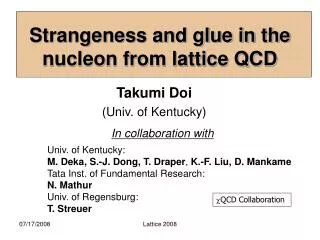
Takumi Doi (Univ. of Kentucky) Strangeness and glue in the nucleon from lattice QCD In collaboration with Univ. of Kentucky: M. Deka, S.-J. Dong, T. Draper, K.-F. Liu, D. Mankame Tata Inst. of Fundamental Research: N. Mathur Univ. of Regensburg: T. Streuer cQCD Collaboration Lattice 2008
Introduction • Nucleon structure • Fundamental particle, but a whole understanding of its structure has not been obtained yet • Spin “crisis” • The EMC experiments (1989) quark spin is only 30% • Orbital angular momentum and/or gluon must carry the rest • Exciting results are coming from experiments • RHIC, JLAB, DESY, … • Inputs from theoretical prediction are necessary for some quantities: e.g., strangeness <x2> Lattice 2008
Introduction • The ingredients: valence/sea quark and gluon • Quark “connected” diagrams • Quark“disconnected insertion” diagrams • Glue what is suitable “glue” operator ? • Disconnected Insertion (D.I.) terms • Now is the full QCD Era: dynamical sea quark ! • Strangeness in <x>, <x2>, electric/magnetic form factors • Glue terms • Glue in <x> • Glue contribution to nucleon spin • necessary to complete (angular) momentum sum rules Tough calculation in lattice Lattice 2008
Outline • Energy-momentum tensor • <x> and spin • <x> from disconnected insertion • <x> from glue • Glue operator from overlap operator • Outlook Lattice 2008
Orbital part Methodology • The energy momentum tensor can be decomposed into quark part and gluon part gauge invariantly • Nucleon matrix elements can be decomposed as • (angular) momentum sum rules (reduce renormalization consts.) X.Ji (1997) Lattice 2008
q p p’=p-q Methodology • <x> can be obtained by To improve S/N, we take a sum over t1=[t0+1, t2-1] t1 t0 t2 Lattice 2008
q p p’=p-q Methodology • Spin components can be obtained by N.B. we use one more equation to extract T1 and T2 separately (q^2 dependence could be different) Lattice 2008
Analysis for <x> (D.I.) c.f. Analysis for <x> (connected) talk by D. Mankame (Mon.) Lattice 2008
Analysis (1) • Nf=2+1 dynamical clover fermion + RG improved gauge configs (CP-PACS/JLQCD) • About 800 configs • Beta=1.83, (a^-1=1.62GeV, a=0.12fm) • 16^3 X 32 lattice, L=2fm • Kappa(ud)=0.13825, 0.13800, 0.13760 • M(pi)= 610 – 840 MeV • Kappa(s)=0.13760 • (Figures are for kappa(ud)=0.13760) Lattice 2008
Analysis (2) • Wilson Fermion + Wilson gauge Action • 500 configs with quenched approximation • Beta=6.0, (a^-1=1.74GeV, a=0.11fm) • 16^3 X 24 lattice, L=1.76fm • kappa=0.154, 0.155, 0.1555 • M(pi)=480-650 MeV • Kappa(s)=0.154 , kappa(critical)=0.1568 • (Figures are for kappa=0.154) Lattice 2008
D.I. calculation • Disconnected diagrams are estimated Z(4) noise (color, spin, space-time) method • #noise = 300 (full), 500 (quenched) (To reduce the possible autocorrelation, we take different noise for different configurations) • We also take many nucleon sources (full: #src=64/32 (lightest mass/others), quenched: #src=16 ) We found that this is very effective (autocorrelation between different sources is small) • CH, H and parity symmetry: • (3pt)=(2pt) X (loop)(3pt) = Im(2pt) X Re(loop) + Re(2pt) X Im(loop) Lattice 2008
Results for <x>(s) Nf=2+1 Linear slope corresponds to signal By increasing the nucleon sources #src = 1 32, the signal becomes prominent Error bar reduced more than factor 5 ! Lattice 2008
Chiral Extrapolation Nf=2+1 <x>(s) <x>(ud) [D.I.] We expect we can furhter reduce the error by subtraction technique using hopping parameter expansion Note: The values are not renormalized Lattice 2008
Ratio of <x>(s) and <x>(ud)[D.I.] Nf=2+1 <x>(s) / <x>(ud)[D.I.] =0.857(40) Preliminary c.f. Quenched <x>(s) / <x>(ud)[D.I.] =0.88(7) M. Deka Note: The values are not renormalized Lattice 2008
Glue calculation • Gluon Operator • Glue operator constructed from link variables are known to be very noise • Smearing ? (Meyer-Negele. PRD77(2008)037501, glue in pion) • Field tensor constructed from overlap operator • Ultraviolet fluctuation is expected to be suppressed • In order to estimate D_ov(x,x), Z(4) noise method is used, where color/spin are exactly diluted, space-time are factor 2 dilution + even/odd dilution, #noise=2 K.-F.Liu, A.Alexandru, I.Horvath PLB659(2008)773 Lattice 2008
Results for <x>(g) (quenched) Linear slope corresponds to signal First time to obtain the signal of glue in nucleon ! c.f. M.Gockeler et al., Nucl.Phys.Proc.supp..53(1997)324 Lattice 2008
Summary/Outlook • We have studied the <x> from strangeness, u, d (disconnected insertion[D.I.]) and glue • Nf=2+1 clover fermion and quenched for <x>(q) • <x>(s) is as large as <x>(ud) [D.I.] • Renormalization is necessary for quantitative results • Glue <x> has been studied using overlap operator • We have obtained a promising signal ! • Outlook • Angular momentum is being studied origin of nuc spin • Various quantities of D.I., strangeness electric/magnetic form factor, pi-N-sigma term, etc. Lattice 2008
Supplement Lattice 2008
Renormalization • We have two operators: T4i(q), T4i(G) • It is known that the RG can be parametrized as • Two unknown parameters can be determined by two sum rules • Momentum sum rule: • Spin sum rule: X.Ji, PRD52 (1995) 271 Lattice 2008