Model-Based Query Processing for Uncertain Time-Series Data in Mobile Geosensor Networks
This paper presents an innovative approach to query processing over uncertain time-series data, specifically within mobile geosensor networks. Our model-based framework provides a mid-level abstraction that produces probabilistic views from raw sensor data, enabling more accurate query results. By continuously updating models and handling spurious data updates effectively, we enhance the reliability of inferences about spatial and temporal phenomena like pollution. Our method is well-suited for community sensing applications and minimizes data storage overhead while maximizing operational efficiency.

Model-Based Query Processing for Uncertain Time-Series Data in Mobile Geosensor Networks
E N D
Presentation Transcript
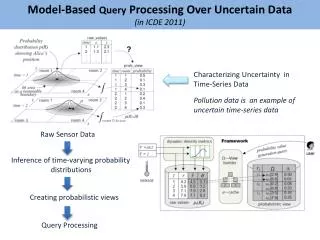
Model-Based Query Processing Over Uncertain Data(in ICDE 2011) Characterizing Uncertainty in Time-Series Data Pollution data is an example of uncertain time-series data Raw Sensor Data Inference of time-varying probability distributions Creating probabilistic views Query Processing
Multi-model Query Processing in Mobile Geosensor Networks Continuous Moving Queries Give a (in car) pollution update every 30 mins • Our Approach • Middle layer that produces a model cover from a set of regression models on an area • Sensor data keeps updating the models • Queries operate on top of the models • Advantages • Key mid-level abstraction helps in handling spurious updates to the data base • Specially suitable for uncontrolled sensory deployments (for ex., community sensing) • Minimizes data storage • Intuition • Queries processed over models should yield accurate results than queries processed over raw values Aggregate Queries COX emitted yesterday in Lausanne center Model-based middle layer DBMS (storage of raw sensor values) Mobile Sensor Data (Pollution Values) Mobile Sensor Data (Pollution Values)
ModelingData from Large-area Community Sensor Networks(in IPSN 2012) Key contributions: Estimation of model cover over large geographical areas (cities/urban spaces) Maintaining the model cover over spatio-temporal evolution of the phenomenon Uncontrolled or semi-controlled mobility of the sensors Adaptive vs. Non-adaptive Non-adaptive: Grid-based methods (GRIB) Adaptive:Adaptive K-means (Ad-KMN) Experimental evaluation over to real datasets Overview of the framework Adaptive K-means