Understanding Volcanoes: Formation, Structure, and Locations
This lesson explores the fascinating world of volcanoes, defining what a volcano is and how it forms. A volcano is an opening in the Earth's crust where molten rock (magma), hot gases, and solid materials erupt. Key components include the vent, where magma escapes; lava, the surface magma; and the crater, which can expand into a caldera after eruptions. We also examine volcanic belts like the Pacific Ring of Fire and their formation at tectonic boundaries, including rift zones and hotspots, illustrating how these powerful geological phenomena shape our planet.

Understanding Volcanoes: Formation, Structure, and Locations
E N D
Presentation Transcript
Chapter 7: Lesson 3 VOLCANOES
Pages D30 and D31 How do Volcanoes Form?
What is a Volcano? • A place where molten rock, hot gases, and solid rock erupt • It is an opening in the crust
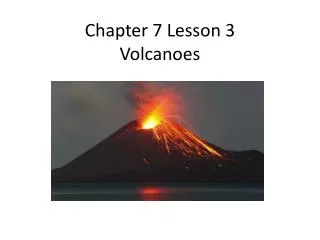
Vent: central opening in a volcanic area through which magma may escape • Lava: magma that comes out of the vent • Erupted material cools and hardens around the vent. This is a volcano!
Crater: a cup-like hollow that forms at the top of a volcano and around the vent.
Volcanoes occur in belts, or long lines... • Pacific Ring of Fire • Circles the Pacific Ocean
Another is located around the Mediterranean Sea through Iran and continues through Indonesia to the Pacific
80% of land volcanoes are found on these two belts • On the ocean floor, volcanoes line the mid-ocean ridges. • Volcanoes form around boundaries
Rift volcanoes: Form at divergent boundaries
Hawaiian Islands • Hot Spot: a hot part of the mantle. Magma melts up through the crust. Middle of the plate is moving over a hot spots