Othon Friesz: Pioneer of Fauvism and Modern Art
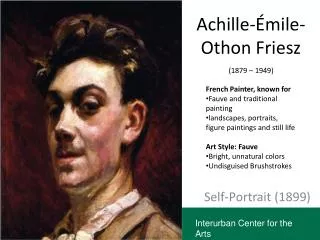
Othon Friesz (1879-1949) was a prominent French artist associated with the Fauvist movement, known for its revolutionary use of color and form. Born into a family of shipbuilders, Friesz studied in Paris, where he joined fellow artists in rebelling against traditional academic styles. His early works from 1907 exemplify Fauvism's boldness. After serving in World War I, his painting style evolved to a more subdued palette. One of his most notable pieces was created for the 1937 Paris World Fair. His art continues to impact the modern artistic landscape, evidenced by a 2007 auction of one of his works for $2.5 million.

Othon Friesz: Pioneer of Fauvism and Modern Art
E N D
Presentation Transcript
Othon Friesz Febuary 6th, 1879 – January 10th, 1949
Othon Friesz was a French artist of the Fauvist Movement. Born in 1879, he was the son of a long line of shipbuilders and sea captains. Roofs and Cathedral in Rouen - 1908
Still Life With a Vase of Tulips Othon studied mostly in Paris. There, he met a group of common artists and together they rebelled against the academic teachings of the time and formed a new group of Fauve painters.
Fauvism was the first truly revolutionary movement within modern art with it’s bold display of color and form. Fauves translated means “The Wild Beasts”. Several of his earlier works, especially from 1907, are regarded as the boldest examples of Fauvism.
The artiste travelled extensively throughout Europe and participated in exhibitions in New York and Chicago. He opened his own studio and began teaching art in Paris until 1914 when he joined the army for the duration of the war.
After the war, Friesz returned to Paris and started painting in a style completely removed from his earlier colleagues. Instead of using the lively and brilliant colors of his Fauve years, he returned to a more sober color scheme.
One of his last greatest works was for the Palais de Chaillot on the occasion of the world fair in Paris in 1937. In 2007 in London, one of the paintings he did in 1906 when he was really at the top of his Fauve game sold for $2.5 million.