Overview of DNA and RNA: Key Concepts in Structure and Replication
This review chapter covers fundamental concepts in DNA and RNA, including structural differences, such as the presence of ribose in RNA and thymine in DNA. It details the process of DNA replication, emphasizing the role of enzymes like helicase and DNA polymerase. Key processes such as the unzipping of DNA strands, the formation of replication forks, and the use of Okazaki fragments in lagging strand synthesis are explained. Additionally, the chapter discusses mutations, including point mutations and frameshift mutations caused by insertions or deletions, and their potential effects.

Overview of DNA and RNA: Key Concepts in Structure and Replication
E N D
Presentation Transcript
DNA Replication Chapter 10
Review of DNA and RNA • 1. Which has ribose of the sugar? • 2. Which is double stranded • 3. Thymine if found in DNA - what is found in RNA instead? • 4. Which base does cytosine pair with? • 5. What makes up the “back bone” of DNA?
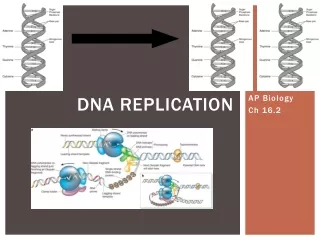
DNA replication • Carried out by enzymes • 1st enzyme (helicase) - “unzips” the 2 strands of DNA (i.e. breaks H bonds), separating base pairs
After unzipping • Each of the separated strands serves as a “template” for making a new double strand
As strands unzip • Replication fork - where 2 strands separated • DNA Polymerase adds complementary base pairs to the exposed bases • Bases can only be added in the 5’-3’ direction
How bases are added • One strand is filled in unbroken; the other strand uses okazaki fragments • Okazaki fragment gaps are filled in by the enzyme DNA ligase
Replication • Occurs at many places along a DNA strand • DNA polymerase - adds about 50-100 new nucleotides per second
As a result... • Two identical DNA molecules result • Mitosis or Meiosis can now occur
Errors in pairing • Can result in mutations • Mutations can be harmful, beneficial or have no effect
Types of Mutations • Point Mutation- An incorrect base is added to a pair in one spot affecting a single amino acid.
Types of Mutation • FrameshiftMutation- Moves the entire frame of DNA • Insertion- An extra base is added in where one should not be shifting the entire reading frame. • Deletion- A base is deleted shifting the entire reading frame back one.