Exploring Themes and Characters in "To Kill a Mockingbird" by Harper Lee
Harper Lee's "To Kill a Mockingbird," set in Maycomb, Alabama, during the 1930s, explores profound themes through the eyes of Scout Finch, a young girl. The novel addresses issues of racism, classism, and moral courage while following the experiences of young Scout and her brother Jem as they navigate their childhood. Key characters include Atticus Finch, the moral backbone of the story, and Tom Robinson, whose trial sparks community conflict. Symbolism, such as the mockingbird, enriches the narrative, reflecting the innocence worth protecting.

Exploring Themes and Characters in "To Kill a Mockingbird" by Harper Lee
E N D
Presentation Transcript
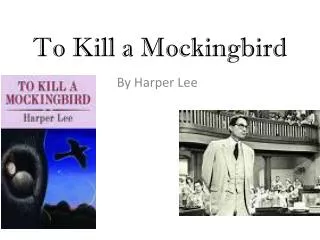
To Kill a Mockingbird By: Harper Lee
Born in Monroeville, Alabama in 1926 • Only wrote one novel, which won the Pulitzer Prize • Mother - Frances Finch Lee • Father - Amasa Coleman Lee (of the Civil War Robert E. Lee) • Father was a lawyer, and Harper studied law but didn’t graduate from law school
Things to Look for While Reading Setting Characters Conflict Climax Conclusion Point of View Symbolism Theme
Setting of the Story • Maycomb, Alabama • Between 1933 and 1936 • Traditional old Southern Town • Small rural town setting where everyone knows everyone.
Characterization • Atticus Finch • Scout Finch • Jem Finch • Dill • Calpurnia • The Radley Family • The Ewell Family • Tom Robinson • The various neighbors, Miss Maudie, Miss Stephanie, Mrs. Dubose etc. • Heck Tate & the Judge
Conflict in the Story * Conflict within the Radley Family (Boo vs. Authority Figure) * Conflict within the community (racism and classism) * Conflict between The Ewells and Tom Robinson * Conflict within families (The Ewells and the Finches)
POINT OF VIEW • Scout Finch • Young Motherless Girl • Antagonistic Tom Boy • Just Beginning School • Fast Temper • “Matter of Fact” Ideas
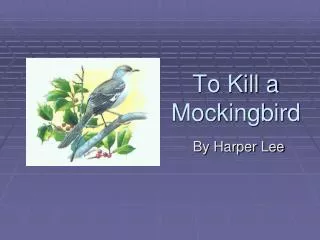
SYMBOLISM • The Mockingbird • The Mad Dog • Mrs. Dubose’s Flowers • The Gray Ghost
THEME • Growing Up (The change from innocent acceptance to skepticism) • Prejudice (Class, Race, and Sexual) • Courage (Physical Courage to Moral Courage) • Compassion • Conscience