Mastering Equivalent Fractions: Simplifying and Understanding the Basics
Learn about equivalent fractions and how to simplify them effectively. Equivalent fractions are fractions that represent the same value, achieved by multiplying or dividing both the numerator and denominator by the same number. Additionally, discover the simplest form of fractions and the rules for simplification, such as identifying prime numbers and applying the greatest common factor (GCF). Build your understanding of fractions with clear examples and rules, ensuring you grasp the fundamental concepts needed for mathematics.

Mastering Equivalent Fractions: Simplifying and Understanding the Basics
E N D
Presentation Transcript
Vocabulary • Equivalent fractions – fractions that name the same number.
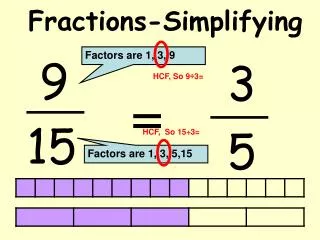
Equivalent Fractions • To find an equivalent fraction you multiply or divide the numerator and the denominator by the same number.
Equivalent Fractions x 2 = x 2
Equivalent Fractions 3 = 3
Vocabulary • Simplest form – when the GCF of the numerator and denominatoris one.
Rules for Simplifying Fractions • When the numerator is 1, the fraction will not reduce. • Example:
Rules for Simplifying Fractions • When the denominator is prime, the fraction will not reduce. • Example: (prime)
Rules for Simplifying Fractions • When the numerator is one less than the denominator, the fraction will not reduce. (Counting order) • Example:
Rules for Simplifying Fractions • When the numerator is prime and does not divide the denominator evenly, the fraction will not reduce. • Example: (prime)
Rules for Simplifying Fractions • When the numerator and the denominator are even, the fraction will always reduce. • Example: 2 = 2
Rules for Simplifying Fractions • When the numerator divides the denominator evenly, the fraction will always reduce. • Example: 5 = 5
Rules for Simplifying Fractions • When the numerator and the denominator can be divided by a common factor, the fraction will always reduce. • Example: 3 = 3