DOE Roles and Responsibilities During Disasters
30 likes | 200 Vues
The Department of Energy (DOE) plays a crucial role in disaster situations by ensuring situational awareness of electric power status, facilitating the removal of barriers for energy infrastructure restoration, and connecting critical facilities to power sources. As the Federal focal point for energy preparedness, the DOE collaborates with sector stakeholders to mitigate “Fed Fatigue,” leverage expertise, and provide essential information on energy supply and demand. Key challenges include damage assessment, access, human safety, and regulatory issues, all vital for a coherent and effective response.


DOE Roles and Responsibilities During Disasters
E N D
Presentation Transcript
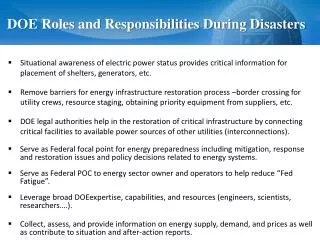
DOE Roles and Responsibilities During Disasters • Situational awareness of electric power status provides critical information for placement of shelters, generators, etc. • Remove barriers for energy infrastructure restoration process –border crossing for utility crews, resource staging, obtaining priority equipment from suppliers, etc. • DOE legal authorities help in the restoration of critical infrastructure by connecting critical facilities to available power sources of other utilities (interconnections). • Serve as Federal focal point for energy preparedness including mitigation, response and restoration issues and policy decisions related to energy systems. • Serve as Federal POC to energy sector owner and operators to help reduce “Fed Fatigue”. • Leverage broad DOEexpertise, capabilities, and resources (engineers, scientists, researchers….). • Collect, assess, and provide information on energy supply, demand, and prices as well as contribute to situation and after-action reports.
Critical Issues and Challenges • Damage Assessment • Access • Storm Response Factors • Human Safety, Economic, Political, Environmental, Logistical, Legal, Regulatory… • Situational Awareness/Communication • Multiple Stakeholders • Competing Priorities • Cascading Impacts • Logistics/Transportation • Competition for Limited Supplies/Resources • Vendor Agreements • Jurisdictional/Regulatory Issues (Cross State/County movement of assets) • Priority of restoration for Critical Infrastructure • Multiple Requirements • Credentialing • Access for Responders/Mutual Aid Workers • Coordination with Law Enforcement • Public Messaging • Standardization of Equipment