Exploring Sunflowers and Prehensile Tails in Nature's Artistry
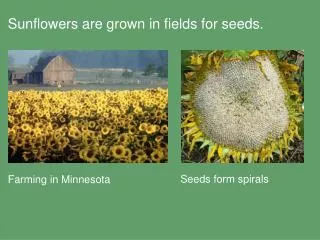
Sunflowers, cultivated in fields, showcase pigments through their spiral-shaped seeds. In Minnesota, hybrid varieties thrive, especially during autumn, like the Great Mammoth sunflower. This beauty raises questions about artistic interpretation—can natural processes be reimagined as art? Also, some animals possess remarkable prehensile tails, enabling them to grasp objects efficiently. Both seahorses and certain lizards demonstrate this unique adaptation, highlighting nature's creativity and complexity. Join us as we delve into the intersection of flora, fauna, and artistry.

Exploring Sunflowers and Prehensile Tails in Nature's Artistry
E N D
Presentation Transcript
Sunflowers are grown in fields for seeds. Seeds form spirals Farming in Minnesota
Sunflowers are hybridized for flowers. Autumn Sunflowers Great Mammoth
The artist can take an event and change it’s perspective A natural process Can it become art?
Many kinds of animals have prehensile tails. Seahorses have prehensile tails. Some lizards have prehensile tails.
Seahorses and Lizards have prehensile tails. Seahorse Lizard
A prehensile tail is a grasping tail. A prehensile tail. Not a prehensile tail.
Prehensile tails can grasp. Prehensile Not prehensile