Download
1 / 10
100 likes | 207 Vues
Explore the known projections of climate change on ocean pH, sea surface temperature, sea level, and more. Delve into the unknown factors like cloud feedbacks and biodiversity impacts. Discover the significance of gaps in knowledge and ways to slow the trajectory of degradation.

E N D
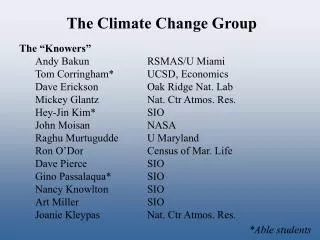
The Climate Change Group • The “Knowers” • Andy Bakun RSMAS/U Miami • Tom Corringham* UCSD, Economics • Dave Erickson Oak Ridge Nat. Lab • Mickey Glantz Nat. Ctr Atmos. Res. • Hey-Jin Kim* SIO • John Moisan NASA • Raghu Murtugudde U Maryland • Ron O’Dor Census of Mar. Life • Dave Pierce SIO • Gino Passalaqua* SIO • Nancy Knowlton SIO • Art Miller SIO • Joanie Kleypas Nat. Ctr Atmos. Res. *Able students
The “Known” Projections of Climate Change best known Ocean pH Sea surface temperature Sea level Ocean stratification Water cycle glaciers and sea ice runoff (region-dependant) precipitation Changes in ocean circulation/wind patterns/upwelling Meridional overturning (thermohaline circulation) Tropical cyclone activity Dust delivery (and trace metals) to the oceans least known
Direct effect of CO2 forcing [CO32-] at 280 ppmv and 560 ppmv
Predicted changes in “Ecosystem Domain Areas” from Climate Models of 2040-2060 Highly productive Productive Weakly productive Oligotrophic Sarmiento et al., 2004
The Unknowns (and why) Forcings: • Feedbacks of clouds on climate • Temporal and spatial variance in all physical variables • Tropical cyclone effects on ventilation (reduction of the “dead zone”) • Effects of human behavior on climate change forcing (CO2, land use, etc.) Biodiversity: • Relationship between productivity and biodiversity in the open ocean • Time-scales of biological adaptation to changes in forcings • Roles of species interactions in modulating biodiversity • Response of subsurface biodiversity to surface changes
The Unknowable, and the significance of not knowing • Behavior of large-scale climate oscillations • PDO/NAO/ENSO • could have large overriding effects • Glacial/Polar ice collapse • not likely, but would have huge impact • THC shutdown • not likely, but would have large impact • Biological ‘surprises’ • e.g., coral bleaching, marine diseases; animal behavior • can completely alter structure of marine biological community
Gaps in knowledge: what do we need to know and why • Time-space patterns of “biodiversity” • baseline data on present-day or past biodiversity • retrospective studies or synthesis of existing data (COML) • Models • include intrinsic population variability necessary to assess biodiversity • higher resolution modeling at ecosystem/community scales • Development of downscaling, esp. in coastal regions • Physiological studies; genetic analyses of plasticity of species’/populations’ environmental tolerances
Is it possible to reverse the trajectory of degradation? NO… but it’s possible to slow the trajectory • Stabilize emissions • does not halt the increase in atmospheric greenhouse gases • DOES reduce the rate of change • Reduce non-climate stresses • Include projections of climate change as a component of conservation design