Unveiling Totalitarianism: What, Where, and Why It Matters
Totalitarianism, a form of government where leaders control every aspect of citizens' lives, is comprised of elements like dictatorship, fascism, tyranny, and communism. Originating as a synonym for dictatorship in Italian Fascism, it now represents complete control and limited rights, witnessed through oppressive regimes like Hitler's and Mussolini's. The distinction between totalitarianism and fascism lies in the degree of control, with the former having more extensive power over its people with fake polls and power struggles. Learn why this matters, how it influences society, and who benefits from this extreme form of governance.

Unveiling Totalitarianism: What, Where, and Why It Matters
E N D
Presentation Transcript
By Max, Michael, and Gabie Totalitarianism
TOE TAL IH TEAR EE UHN IHZ UM
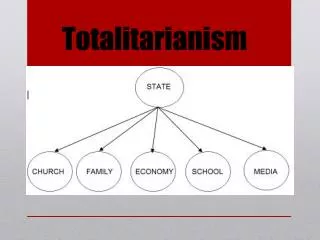
What is it? • Definition • A form of government in which the leader(s) control every aspect of his/her people’s lives. • Elements of • Dictatorship • Fascism • Tyranny • Communism
Explaining Time! Square and Rectangle Insect and Bug (A Totalitarinist nation is a very strict Dictatorship.)
Where did it come from? • Originally synonym for dictatorship • Italian Fascism • Giovanni Amendola • Inventor • Based on Fascism • Mussolini coined the term
Why does it matter? • Virtually no Rights • Complete control • E.G. The ruler doesn’t like hopscotch, so little children can get in trouble for playing hopscotch.
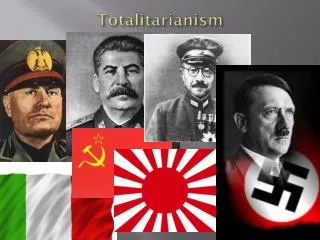
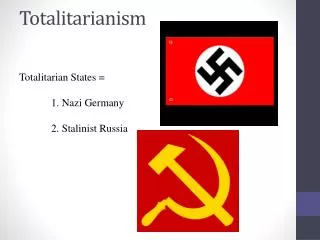
Who uses it? • Dictators • Most Famous • Hitler • Mussolini
Religion (In an extreme sense) • Totalitarianists • Priests/ Rabbis • Full control on life • All powerful Gods
Difference Fascism Totalitarianism Less control than totalitarianism More control One race/group is superior to everything else. One person in charge of everything
Power is passed by… • Fake polls • There is often a power struggle if multiple people are in the same power. • There is a line of secession.